
The Cell BriefHormones
Sermorelin: The Brain's Growth Signal, Cut Down to Size
A short, lab-made copy of the brain's signal to let out growth hormone. Here is its surprising backstory and what studies in cells, rats and people found.
Deep in your brain, a tiny signal tells your body when to let out growth hormone. It is called GHRH. Scientists knew the brain made it. But they could not pin it down.
Then, in 1982, they found it in a strange place: a tumor in the pancreas. The tumor made so much of the signal that a patient's body overgrew. Sermorelin is a short, lab-made copy of that signal.
What it is
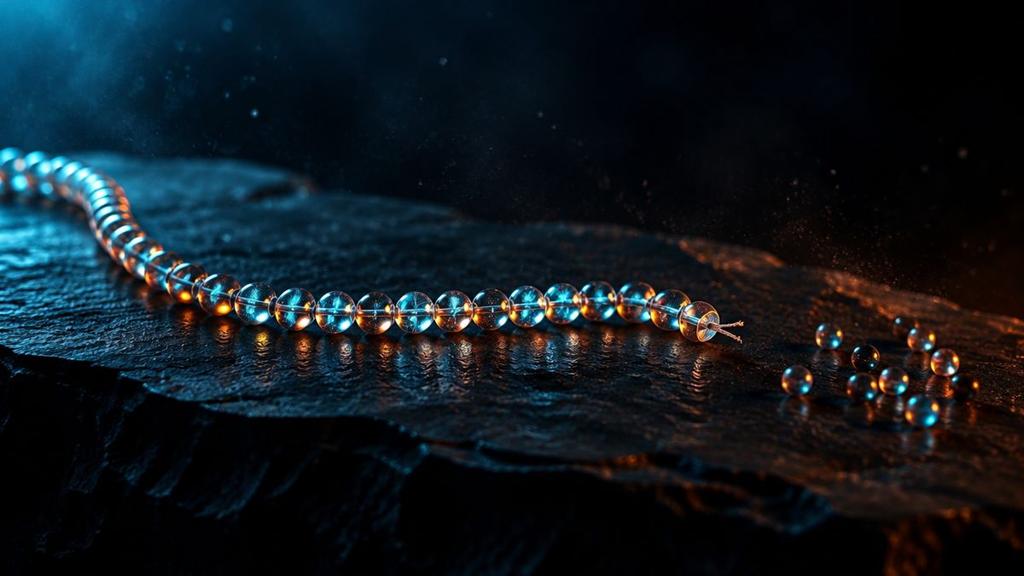
A peptide is a short chain of amino acids. Think of amino acids as beads and a peptide as a short bead bracelet. New to this? Start with what a peptide is.
The tumor's signal was a chain of 44 beads. Soon, scientists made a fun find. The first 29 beads alone could still do the job.
Sermorelin is a lab-made copy of those first 29 beads.
It became a real medicine, called Geref. In 1990, the FDA approved it as a test. It showed whether a person's pituitary could make growth hormone. In 1997, it was approved for some children who grew too slowly because they made too little growth hormone.
What it does in the body
Sermorelin works on the pituitary. That is a pea-sized gland under the brain, where growth hormone is made.

Think of a receptor as a lock on a cell and a peptide as the key. Cells in this gland carry a lock for GHRH. When GHRH turns it, the gland lets out growth hormone.
Sermorelin is a copy of the key. It fits the same lock and turns it.
Growth hormone then tells the body to make IGF-1, a helper hormone.
Here is the clever part. Sermorelin does not replace growth hormone. It asks the gland to let out its own. That way, the body keeps its natural pattern.
It is quick, though. In the blood, half of it is gone in about 6 to 7 minutes.
What scientists have found
In cells: In 1984, scientists tried shorter and shorter copies of GHRH on rat pituitary cells in a dish. The 29-bead version still made the cells let out growth hormone. It was about half as strong as the full chain. Cut down to 19 beads, it stopped working.

In animals: In a 1999 study, young and old rats got the 29-bead chain for two weeks. In old rats, the higher of two amounts helped their locks grab the key as tightly as young rats' locks. Their IGF-1 had dipped with age. It went back to normal.
Young rats reacted differently. The same amount lowered their IGF-1 a little and slowed their growth.
In people: The biggest story is growth. In a 1996 study, 110 children with low growth hormone got sermorelin for up to a year. On average, their growth speed nearly doubled within six months. About three in four had a good response, and they handled it well.
Researchers also asked about aging. Growth hormone and IGF-1 tend to fall as people get older.
In a 1992 study, 10 healthy older men, about 68 on average, got two amounts of sermorelin, two weeks each. At the higher amount, their growth hormone and IGF-1 rose to levels like those of young men. Their blood sugar and blood pressure did not change.
Geref's European label listed a warm, flushed face and pain where the shot went in. These came now and then and most often faded within minutes.
Where it stands
Sermorelin was FDA-approved as Geref. Its maker stopped selling it in 2008, and the approval was withdrawn in 2009 at the maker's request. In 2013, the FDA said it had not been pulled for safety or effectiveness reasons. It is on the World Anti-Doping Agency's banned list.
One big question is still open. Could longer use change the body's makeup in older men? Longer, careful studies would be the exciting next step.
Curious about other growth hormone peptides? See CJC-1295 and ipamorelin.
The bottom line
- Sermorelin is a lab-made copy of the first 29 beads of GHRH, the brain's signal to let out growth hormone.
- It asks the gland to release its own growth hormone. In a study of children with low growth hormone, growth speed nearly doubled in six months.
- Once FDA-approved as Geref, it was withdrawn, but not for safety or effectiveness reasons. What longer use does is the next big question.
FAQ
Questions people ask
- What is sermorelin?
- Sermorelin is a lab-made peptide that copies the first 29 amino acids of GHRH. GHRH is the brain's signal that tells the pituitary to let out growth hormone.
- Is sermorelin FDA approved?
- Not anymore. It was approved as Geref in 1990 and 1997, but its maker stopped selling it in 2008, and in 2013 the FDA said it was not withdrawn for safety or effectiveness reasons.
- What are the side effects of sermorelin?
- Geref's European label listed a warm, flushed face and pain at the injection site, which usually faded within a few minutes. In a year-long study of 110 children, it was well tolerated.
- What is the difference between sermorelin and growth hormone?
- Growth hormone is the hormone itself. Sermorelin copies the brain signal that asks the pituitary to let out its own growth hormone, keeping the body's natural pattern of release.
Sources8
- Growth hormone-releasing factor from a human pancreatic tumor that caused acromegaly · Science, 1982 · DOI 10.1126/science.6812220
- Synthesis and in vitro bioactivity of C-terminal deleted analogs of human growth hormone-releasing factor · Biochemical and Biophysical Research Communications, 1984 · DOI 10.1016/0006-291x(84)90309-7
- Differential in vivo regulation of the pituitary growth hormone-releasing hormone (GHRH) receptor by GHRH in young and aged rats · Endocrinology, 1999 · DOI 10.1210/endo.140.6.6760
- Once daily subcutaneous growth hormone-releasing hormone therapy accelerates growth in growth hormone-deficient children during the first year of therapy (Geref International Study Group) · The Journal of Clinical Endocrinology & Metabolism, 1996 · DOI 10.1210/jcem.81.3.8772599
- Growth hormone (GH)-releasing hormone-(1-29) twice daily reverses the decreased GH and insulin-like growth factor-I levels in old men · The Journal of Clinical Endocrinology & Metabolism, 1992 · DOI 10.1210/jcem.75.2.1379256
- Determination That GEREF (Sermorelin Acetate) Injection ... Were Not Withdrawn From Sale for Reasons of Safety or Effectiveness · U.S. Food and Drug Administration, Federal Register 78 FR 14095, 2013
- GEREF 50: Summary of Product Characteristics · Irish Medicines Board (now Health Products Regulatory Authority), Serono label, 2004
- 2026 Prohibited List, World Anti-Doping Code (English text, published in Tractatenblad 2026, 25) · World Anti-Doping Agency, via the Kingdom of the Netherlands Treaty Series (Tractatenblad), 2026
Education only. Not medical advice. The Cell Brief summarises published research for general education. It is not medical advice, and nothing here is a recommendation to use any compound.
Which peptide family should you explore first?
Answer a few questions about your everyday life. Get your peptide family, the briefs to read first, and the full list in your inbox.
Take the quiz