The Cell BriefHormones
Gonadorelin: The Nobel-Winning Brain Signal That Runs on Rhythm
Gonadorelin is a lab-made copy of GnRH, a tiny brain signal found in a Nobel-winning race. Its big surprise: the beat matters.

Starting in the late 1950s, two rival teams raced to find hidden signals in the brain. One team worked with about 5 million bits of sheep brain. The other used as much from pigs.
Their hunt won a Nobel Prize in 1977. One of the signals they found is called GnRH. Gonadorelin is its lab-made twin. And its story has a fun twist: with this hormone, the beat matters.
What it is
Gonadorelin is a lab-made copy of GnRH, short for gonadotropin-releasing hormone. It has the very same parts, in the same order, as the GnRH your brain makes.
GnRH is a peptide, a short chain of amino acids. Think of amino acids as beads and a peptide as a short bead bracelet.
GnRH is a bracelet of 10 beads. New to this? Start with what a peptide is.
The pig team was first to work out its bead order. Soon, both teams could build it in the lab.
What it does in the body
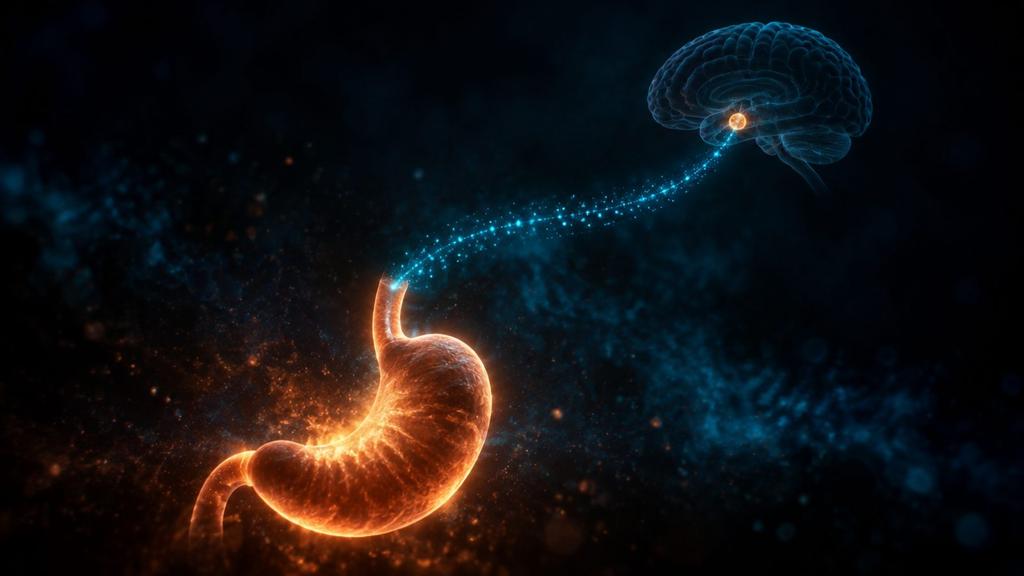
Gonadorelin works the same way as the brain's own GnRH. GnRH is made in the hypothalamus, a small spot at the base of the brain. From there, it travels a short way to the pituitary, a small gland right below.
At the pituitary, it tells cells to let out two more hormones, LH and FSH. Those two travel to the testes or ovaries. There, they help make sex hormones like testosterone, plus sperm or eggs.
Testosterone is a steroid, not a peptide. Here is how the two differ.
Gonadorelin does not last long. Half of it is gone from the blood in about 4 minutes.
Now the twist. In the body, GnRH comes in short bursts, not a steady stream. And the pituitary cares about that beat.
Think of a bell. Tap it now and then, and it rings each time. Keep your hand pressed on it, and it goes quiet.

Want to go one step up the chain? Meet kisspeptin, the signal that wakes GnRH up.
What scientists have found
In cells: In 1981, scientists grew rat pituitary cells on tiny beads, with fluid flowing past. A steady flow of GnRH made the cells pour out about 20 times more LH and FSH. But within 12 hours, that fell back to normal.
Bursts of GnRH kept the cells answering for more than a day.
In animals: A 1978 study used monkeys whose brains could no longer send the signal. A steady drip of GnRH did not keep LH and FSH going. One pulse an hour did. That matched the monkeys' natural beat.
Switching back to a steady drip could shut the response down again. The pattern mattered more than the amount.

Cows add a newer story. In cows, gonadorelin makes the pituitary let out LH, which can make an ovary release an egg.
In a study on six dairy farms, 1,142 cows were bred on a fixed schedule. About 17% got pregnant without gonadorelin. With it, 27% to 32% did.
In people: In 1982, researchers studied six men who had not gone through normal puberty. Researchers thought the cause was a faulty GnRH signal.
A small pump gave them GnRH in pulses, like the brain does. Within a week, their LH and FSH reached normal adult levels. After a month, testosterone was nearly seven times higher on average.
By 43 weeks, three of the six men were making sperm.
Where it stands
In the US, gonadorelin was FDA-approved for people as Factrel in 1982 and as Lutrepulse in 1989. Both have since been discontinued.
In the UK, it is licensed as a one-time test. A normal rise in LH afterward shows the pituitary can answer.

Today in the US, its FDA-approved uses are in cattle. It helps treat ovarian cysts and time breeding.
Its biggest gift to science is a lesson about rhythm. The exciting next step is learning even more about how the brain keeps its hormone beat.
The bottom line
- Gonadorelin is a lab-made copy of GnRH, a 10-bead brain signal found in a Nobel-winning race.
- It tells the pituitary to let out LH and FSH. In cells and monkeys, bursts kept that going, while a steady stream made it go quiet.
- FDA-approved for people in the 1980s, it is FDA-approved for cattle today. Its big lesson for science: rhythm matters.
FAQ
Questions people ask
- What is gonadorelin?
- Gonadorelin is a lab-made copy of GnRH, a brain hormone made of 10 amino acids. It tells the pituitary gland to let out LH and FSH, two hormones that steer the testes and ovaries.
- Is gonadorelin FDA approved?
- For people, it was FDA-approved as Factrel in 1982 and as Lutrepulse in 1989, and both have since been discontinued in the US. Today, its FDA-approved uses are in cattle.
- What are the side effects of gonadorelin?
- Its UK label lists pain, swelling and itching as uncommon. Headache, dizziness, nausea, flushing and allergic reactions are listed as rare.
- What is the difference between gonadorelin and hCG?
- hCG is a hormone made during pregnancy, and it acts like LH, one of the pituitary's own signals. Gonadorelin works one step earlier: it prompts the pituitary to let out the body's own LH, plus FSH.
Sources8
- Press release: The Nobel Prize in Physiology or Medicine 1977 · Karolinska Institutet (NobelPrize.org), 1977
- Desensitization to gonadotropin-releasing hormone observed in superfused pituitary cells on Cytodex beads · Endocrinology, 1981 · DOI 10.1210/endo-108-3-752
- Hypophysial responses to continuous and intermittent delivery of hypopthalamic gonadotropin-releasing hormone · Science, 1978 · DOI 10.1126/science.100883
- Induction of puberty in men by long-term pulsatile administration of low-dose gonadotropin-releasing hormone · New England Journal of Medicine, 1982 · DOI 10.1056/NEJM198211113072003
- Drugs@FDA: FACTREL (gonadorelin hydrochloride), NDA 018123 · U.S. Food and Drug Administration, 2026
- Drugs@FDA: LUTREPULSE KIT (gonadorelin acetate), NDA 019687 · U.S. Food and Drug Administration, 2026
- FACTREL (gonadorelin hydrochloride) injection, for use in cattle only: label, FDA NADA 139-237 · DailyMed (U.S. National Library of Medicine), 2025
- Gonadorelin powder for solution for injection: Summary of Product Characteristics · electronic medicines compendium (emc), UK, 2022
Education only. Not medical advice. The Cell Brief summarises published research for general education. It is not medical advice, and nothing here is a recommendation to use any compound.
Which peptide family should you explore first?
Answer a few questions about your everyday life. Get your peptide family, the briefs to read first, and the full list in your inbox.
Take the quiz