
The Cell BriefHormones
Ipamorelin: The Peptide That Found the Lock Before the Key
A five-bead peptide that copies ghrelin, the stomach's hunger hormone, to cue a pulse of growth hormone. Scientists found its lock before its key.

In 1998, chemists in Denmark described a tiny new peptide called ipamorelin. It fit a lock on cells that sets off growth hormone. There was one fun puzzle. Nobody had found the body's own key for that lock yet.
A year later, scientists found it in the stomach. It was ghrelin, now known as the "hunger hormone." Ipamorelin had found the lock before the key.
It was also picky. In pigs, it raised growth hormone and left a stress hormone alone.
What it is
A peptide is a short chain of amino acids. Think of amino acids as beads and a peptide as a short bead bracelet.
Ipamorelin is a bracelet of just 5 beads. A few of them are not found in nature. Chemists at the drug company Novo Nordisk built it.
The missing key turned up in 1999, when a team in Japan found it in rat stomachs. They named it ghrelin, after an old root word that means "grow." Ghrelin is one of the five peptides your body makes every day.

Ghrelin earned its nickname in a 2001 study. Nine healthy people got a ghrelin drip on one day and a salt-water drip on another. On the ghrelin day, every one of them ate more at a buffet, 28% more on average.
What it does in the body
Growth hormone is made in the pituitary. That is a pea-sized gland at the base of the brain. As its name says, growth hormone helps the body grow.
Cells in the pituitary carry a lock for ghrelin. Think of a receptor as a lock and a peptide as a key. Ipamorelin is a copy of the key. It fits the same lock and turns it.
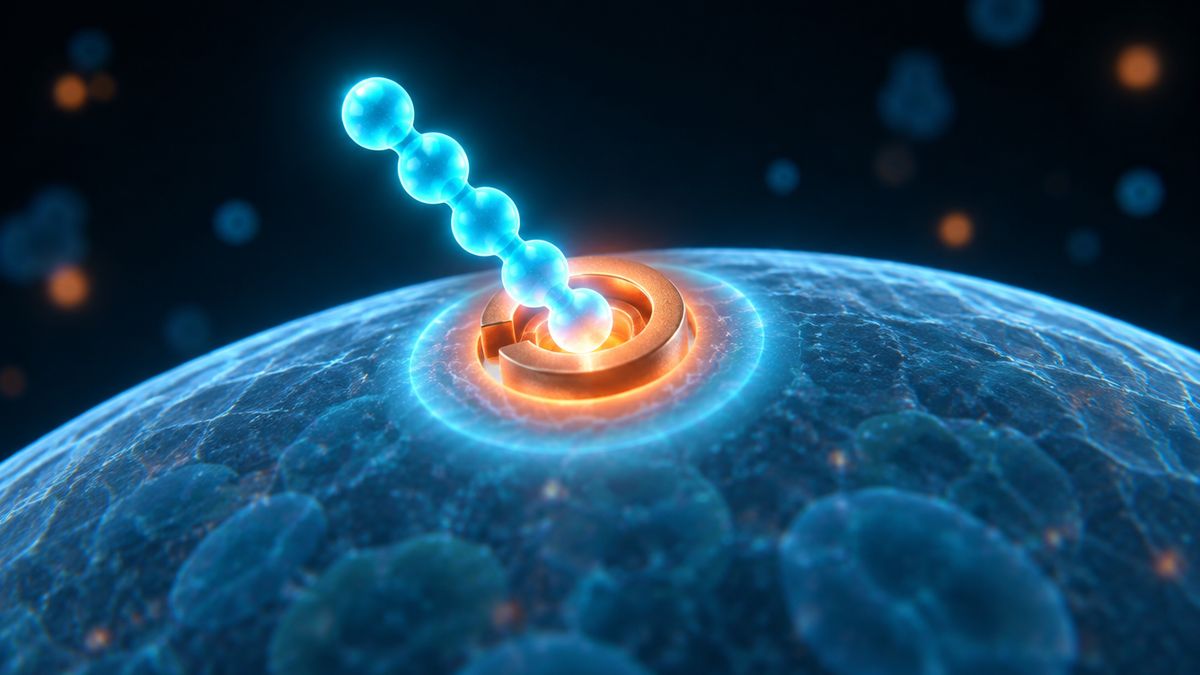
When the lock turns, the pituitary lets out a pulse of growth hormone. A pulse is a quick burst that then fades. Think of one sweep of a lighthouse beam.
Its makers called it the first "selective" peptide of its kind. That means it seemed to switch on growth hormone and leave other hormones alone. The animal studies below show why.
What scientists have found
In cells: In rat pituitary cells in a dish, ipamorelin made the cells release growth hormone. It worked about as well as an older lab-made peptide that uses the same lock.
In animals: In rats and pigs, ipamorelin raised growth hormone in the blood.
In pigs, ipamorelin raised growth hormone without raising cortisol, a stress hormone, even at far higher amounts. Two older look-alikes did raise cortisol. None of them raised prolactin, a hormone tied to making milk.
In a 1999 study, adult female rats got ipamorelin for 15 days. Their shin bones grew in length up to about 24% faster than in untreated rats. They also gained more weight.
In people: In a 1999 study, healthy men got ipamorelin through a drip. Each time, it set off a single burst of growth hormone. The burst peaked about 40 minutes later, then faded away.

Ghrelin's lock also helps keep the gut moving. So researchers had a smart idea. They tested ipamorelin after bowel surgery, when the gut often slows down or stalls for a while. Doctors call this postoperative ileus.
In a trial of 114 adults, the ipamorelin group handled a solid meal about 7 hours sooner than the placebo group, though the gap was too small to be sure it was real. People handled ipamorelin well.
Where it stands
Ipamorelin is not approved by the FDA. It is on the World Anti-Doping Agency's prohibited list.
Researchers are still curious whether a "selective" growth hormone pulse could help people, and in which conditions. Careful, larger studies in people would be the exciting next step.
Curious about another hormone peptide made by the body? Read our brief on oxytocin.
The bottom line
- Ipamorelin is a 5-amino-acid lab-made peptide that fit ghrelin's lock in the pituitary a year before ghrelin was found.
- In pigs, it raised growth hormone without raising cortisol. That is why its makers called it "selective."
- In healthy men, it set off a single pulse of growth hormone. It is one to watch as researchers keep learning.
FAQ
Questions people ask
- What is ipamorelin?
- Ipamorelin is a lab-made peptide of just 5 amino acids. Chemists at Novo Nordisk described it in 1998, a year before scientists found ghrelin, the body's own key to the same lock in the pituitary.
- How does ipamorelin work?
- It fits the same receptor as ghrelin, the stomach's hunger hormone. In animals and in healthy men, this set off a burst of growth hormone.
- Why is ipamorelin called selective?
- In a 1998 study in pigs, it raised growth hormone without raising cortisol, a stress hormone, or prolactin. Two older look-alikes did raise cortisol.
- Is ipamorelin approved by the FDA?
- Ipamorelin has been tested in healthy men and in a trial after bowel surgery, but it is not approved by the FDA.
Sources8
- Ipamorelin, the first selective growth hormone secretagogue · European Journal of Endocrinology, 1998 · DOI 10.1530/eje.0.1390552
- Ghrelin is a growth-hormone-releasing acylated peptide from stomach · Nature, 1999 · DOI 10.1038/45230
- Ghrelin enhances appetite and increases food intake in humans · The Journal of Clinical Endocrinology & Metabolism, 2001 · DOI 10.1210/jcem.86.12.8111
- Ipamorelin, a new growth-hormone-releasing peptide, induces longitudinal bone growth in rats · Growth Hormone & IGF Research, 1999 · DOI 10.1054/ghir.1999.9998
- Pharmacokinetic-pharmacodynamic modeling of ipamorelin, a growth hormone releasing peptide, in human volunteers · Pharmaceutical Research, 1999 · DOI 10.1023/a:1018955126402
- Prospective, randomized, controlled, proof-of-concept study of the Ghrelin mimetic ipamorelin for the management of postoperative ileus in bowel resection patients · International Journal of Colorectal Disease, 2014 · DOI 10.1007/s00384-014-2030-8
- FDA Briefing Document, Pharmacy Compounding Advisory Committee: FDA Evaluation of Ipamorelin (Free Base) and Ipamorelin Acetate · U.S. Food and Drug Administration, 2024
- The ITA provisionally suspends rider S'annara Grove for her apparent ADRV · International Testing Agency (ITA), 2026
Education only. Not medical advice. The Cell Brief summarises published research for general education. It is not medical advice, and nothing here is a recommendation to use any compound.
One brief a week
One brief per compound. Unsubscribe anytime.