The Cell BriefHormones
Oxytocin: The 9-Bead Peptide of Birth, Milk and a Dog's Gaze
A tiny peptide made deep in the brain drives labor and milk let-down. Here is what studies in cells, animals and people have found about it, bonding included.
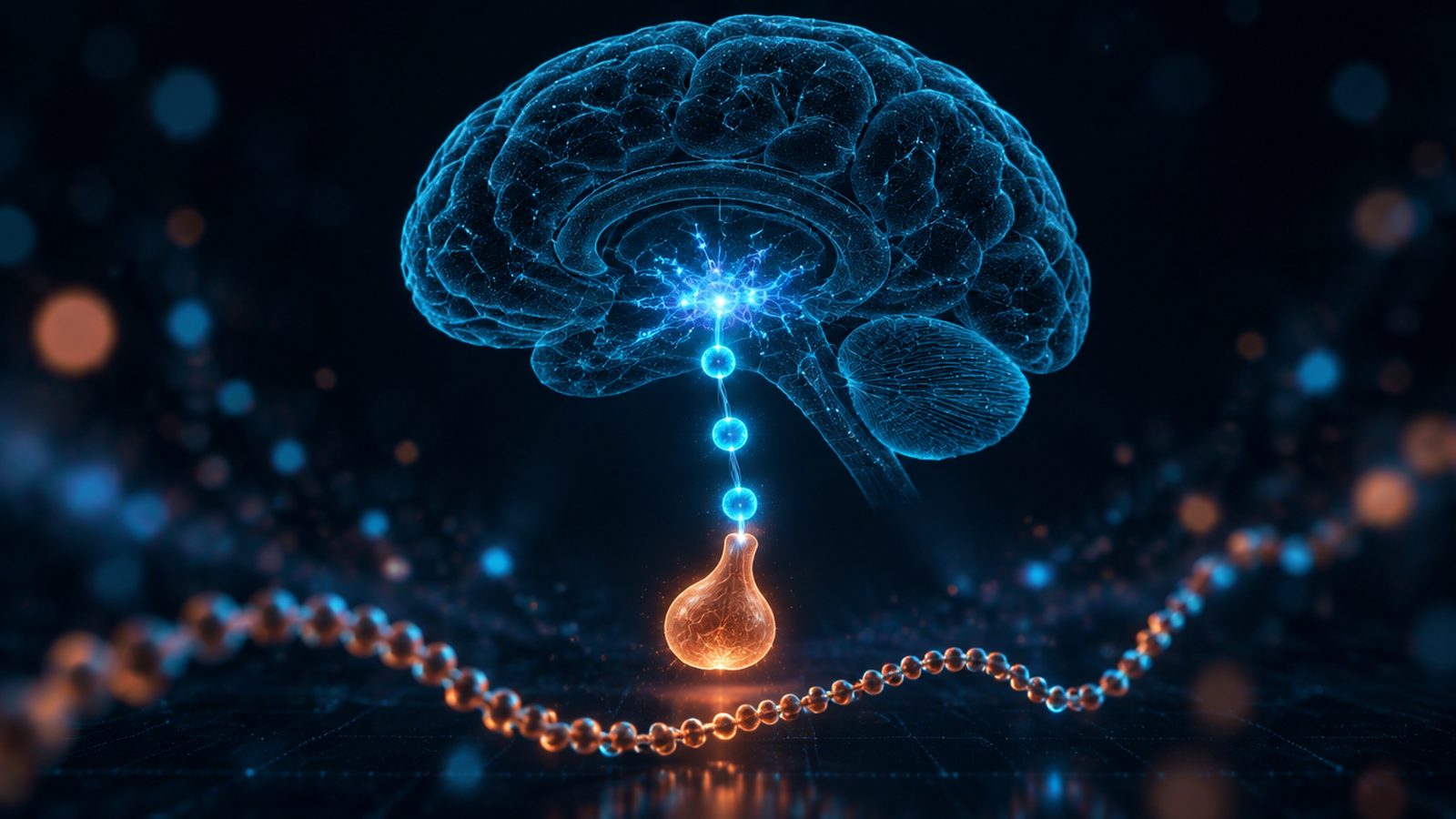
Think of a baby being born. A mother feeding that baby. A dog gazing up at its owner.
One tiny molecule shows up in all three stories. It is called oxytocin, and your brain has made it your whole life.
What it is
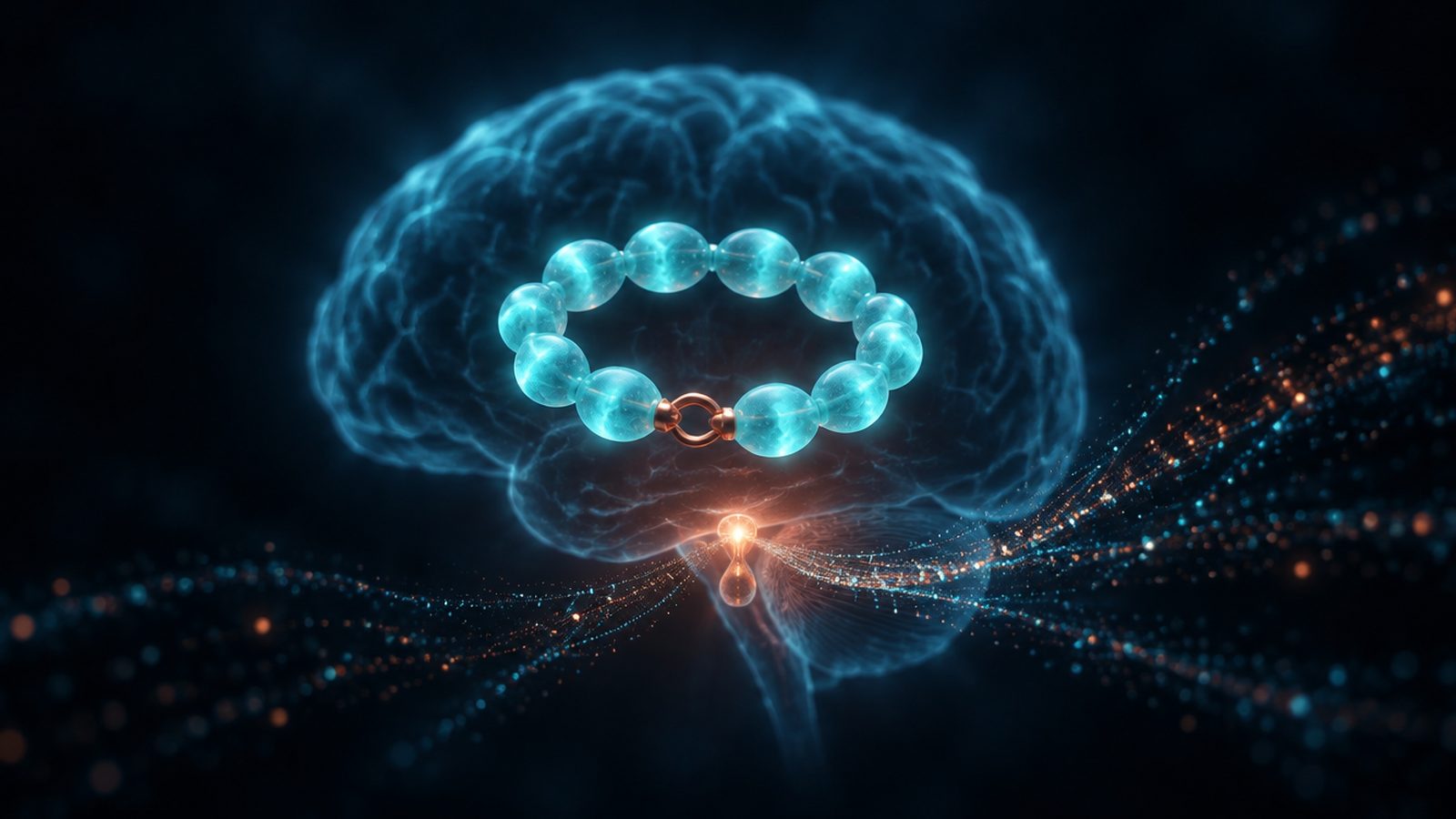
A peptide is a short chain of amino acids. Picture amino acids as beads and a peptide as a short bead bracelet. Oxytocin is one of the five peptides your body makes every day.
Oxytocin is a bracelet of just 9 beads. Two of the beads are joined by a tiny clasp, which pulls part of the chain into a loop.
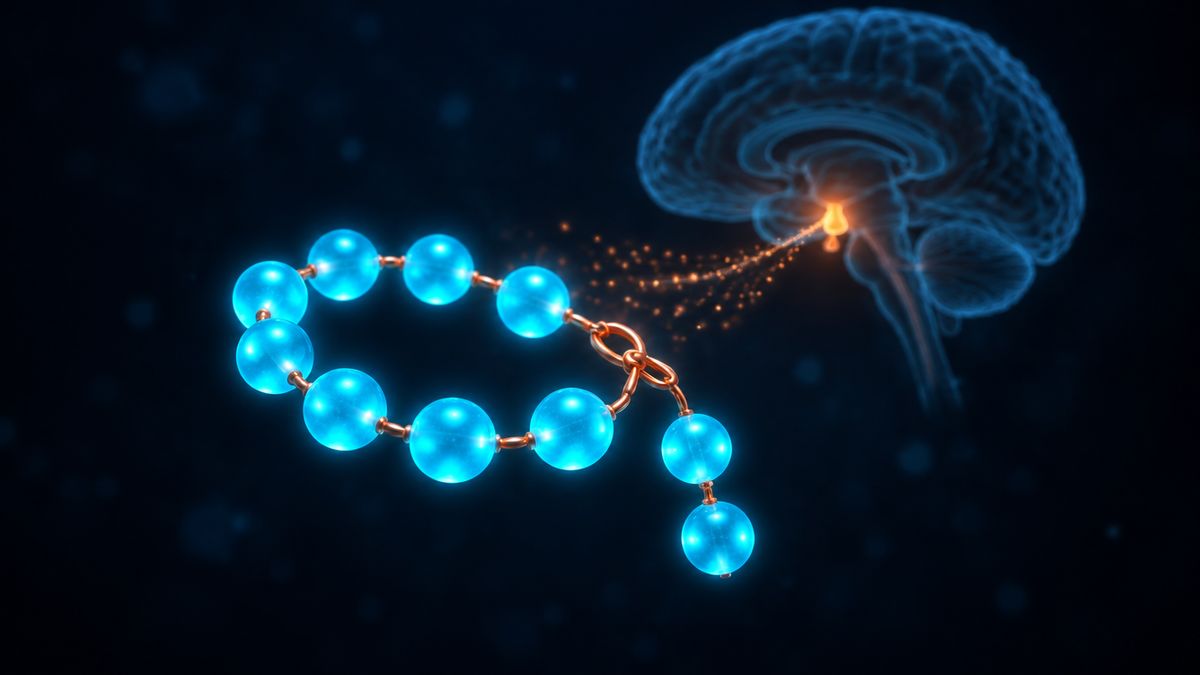
It is made by nerve cells deep in the brain, in a region called the hypothalamus. From there it travels to the pituitary, a small gland at the base of the brain. The gland releases it into the blood.
People noticed its power long before they knew its shape. In 1906, scientists saw that something from this gland made the womb squeeze. In 1910, others saw that it made milk flow.
In 1953, a chemist's team worked out the order of all 9 beads. Then they built the peptide from scratch in the lab. It was the first peptide hormone ever built that way, and it won the 1955 Nobel Prize in Chemistry.
What it does in the body
Oxytocin works like a key. It fits one lock, called a receptor, on the outside of a cell. When the key turns, the cell gets a message.
In the womb, the message is "squeeze." During labor, the muscle of the womb contracts in waves. Oxytocin drives those waves.
In the breast, the message is "let go." When a baby nurses, oxytocin tells the breast to push milk out. This is called let-down.
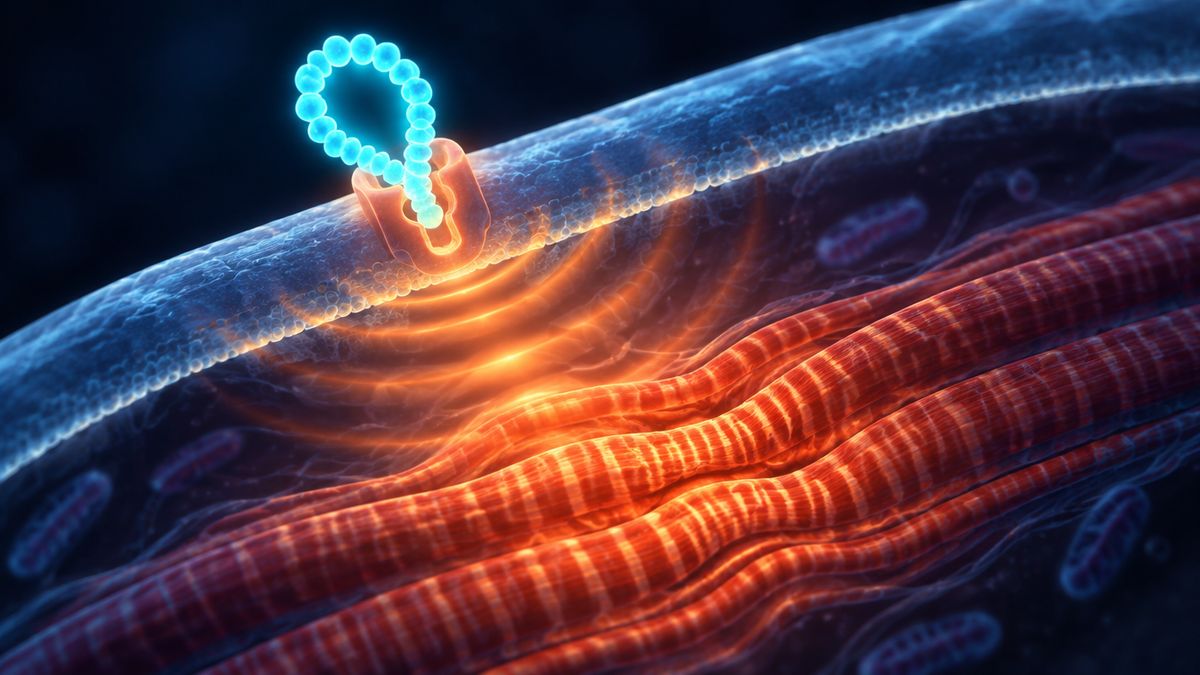
Oxytocin also acts inside the brain itself. There it passes messages between nerve cells. That is where the bonding story begins.
What scientists have found
In cells: The oxytocin lock belongs to a large, well-studied family of receptors. When the key fits, it sets off a relay of signals inside the cell. In muscle cells, that relay ends in a squeeze.
In animals: Virgin female rats do not usually care for pups. A 1979 study tested that. When oxytocin was placed into their brains, 42% started to care for the pups like mothers. None of the rats given salt water did.
Prairie voles are small rodents that pair up for life. In a 1994 study, females given oxytocin in the brain spent six hours with a male. Afterward, they chose him over a stranger. Blocking the lock stopped the effect.
In a 2015 study, dogs gazed at their owners. The owners' oxytocin rose, and so did the dogs'. Wolves did not do this. When dogs got oxytocin by nose, they gazed even longer, and their owners' oxytocin rose again. The team called it a loop.

In people: In 2005, a study in Nature made headlines. People who sniffed an oxytocin spray gave more to a partner in a money game called the trust game. It did not make them take more risks in general.
Then came the hard part. Other teams tried to repeat it. Their results were mixed, and no clear answer came out.
In 2020, a large study set out to repeat the 2005 test. It used a placebo, a dummy spray, and nobody knew who got what. In the setup that matched the original, it found no effect of oxytocin on trust.
That is how science works. A first result is a question. Many studies are the answer.
Where it stands
Synthetic oxytocin is an FDA-approved medicine. Hospitals use it to start or strengthen labor for medical reasons and to help control bleeding after birth.
Oxytocin's role in bonding is still an open question. Researchers want to know how the oxytocin inside the brain shapes trust and care in people, and why the spray studies disagree.
Another brain hormone that steers the body's big moments is kisspeptin.
The bottom line
- Oxytocin is a 9-amino-acid peptide made deep in the brain. It drives labor contractions and milk let-down.
- In rats, voles and dogs, it is tied to mothering, pairing up and gazing.
- In people, the famous trust-spray result did not hold up in a large 2020 test. The bonding story is still being written.
FAQ
Questions people ask
- What is oxytocin?
- Oxytocin is a peptide, a short chain of 9 amino acids. Nerve cells deep in the brain make it, and a gland at the base of the brain releases it into the blood.
- What does oxytocin do during labor and breastfeeding?
- It tells the muscle of the womb to contract in waves during labor. When a baby nurses, it tells tiny muscles in the breast to tighten so milk flows.
- Does oxytocin make people trust each other?
- A 2005 study said sniffing oxytocin raised trust in a money game. Later results were mixed, and a large 2020 repeat of the test found no effect on trust.
- Is oxytocin an approved medicine?
- Yes. Synthetic oxytocin is FDA-approved. Hospitals use it to start or strengthen labor for medical reasons and to help control bleeding after birth.
Sources8
- Oxytocin: the Great Facilitator of Life · Progress in Neurobiology, 2009 · DOI 10.1016/j.pneurobio.2009.04.001
- The Nobel Prize in Chemistry 1955 · NobelPrize.org (Nobel Prize Outreach), 1955
- Induction of maternal behavior in virgin rats after intracerebroventricular administration of oxytocin · Proceedings of the National Academy of Sciences, 1979 · DOI 10.1073/pnas.76.12.6661
- Oxytocin administered centrally facilitates formation of a partner preference in female prairie voles (Microtus ochrogaster) · Journal of Neuroendocrinology, 1994 · DOI 10.1111/j.1365-2826.1994.tb00579.x
- Oxytocin-gaze positive loop and the coevolution of human-dog bonds · Science, 2015 · DOI 10.1126/science.1261022
- Oxytocin increases trust in humans · Nature, 2005 · DOI 10.1038/nature03701
- A registered replication study on oxytocin and trust · Nature Human Behaviour, 2020 · DOI 10.1038/s41562-020-0878-x
- PITOCIN (oxytocin injection) prescribing information, NDA018261 · DailyMed (U.S. National Library of Medicine); labeler Par Health USA, 2023
Education only. Not medical advice. The Cell Brief summarises published research for general education. It is not medical advice, and nothing here is a recommendation to use any compound.
One brief a week
One brief per compound. Unsubscribe anytime.