The Cell BriefBrain
Dihexa: The Peptide-Like Molecule Built for Brain Connections
Scientists built dihexa from a piece of a blood-pressure hormone to help brain cells grow new connections. Here is what labs have found so far.

Your brain runs on connections. Each brain cell reaches out with branches, like a tree. Where two cells meet, they build a tiny bridge to pass messages.
Learning seems to need new bridges. So what if a molecule could help brain cells build more of them? In 2012, a team at Washington State University reported a small, lab-made molecule designed to do just that. They called it dihexa.
What it is
Dihexa started with angiotensin, a hormone best known for helping control blood pressure. The body breaks one form of it into a smaller piece called angiotensin IV.
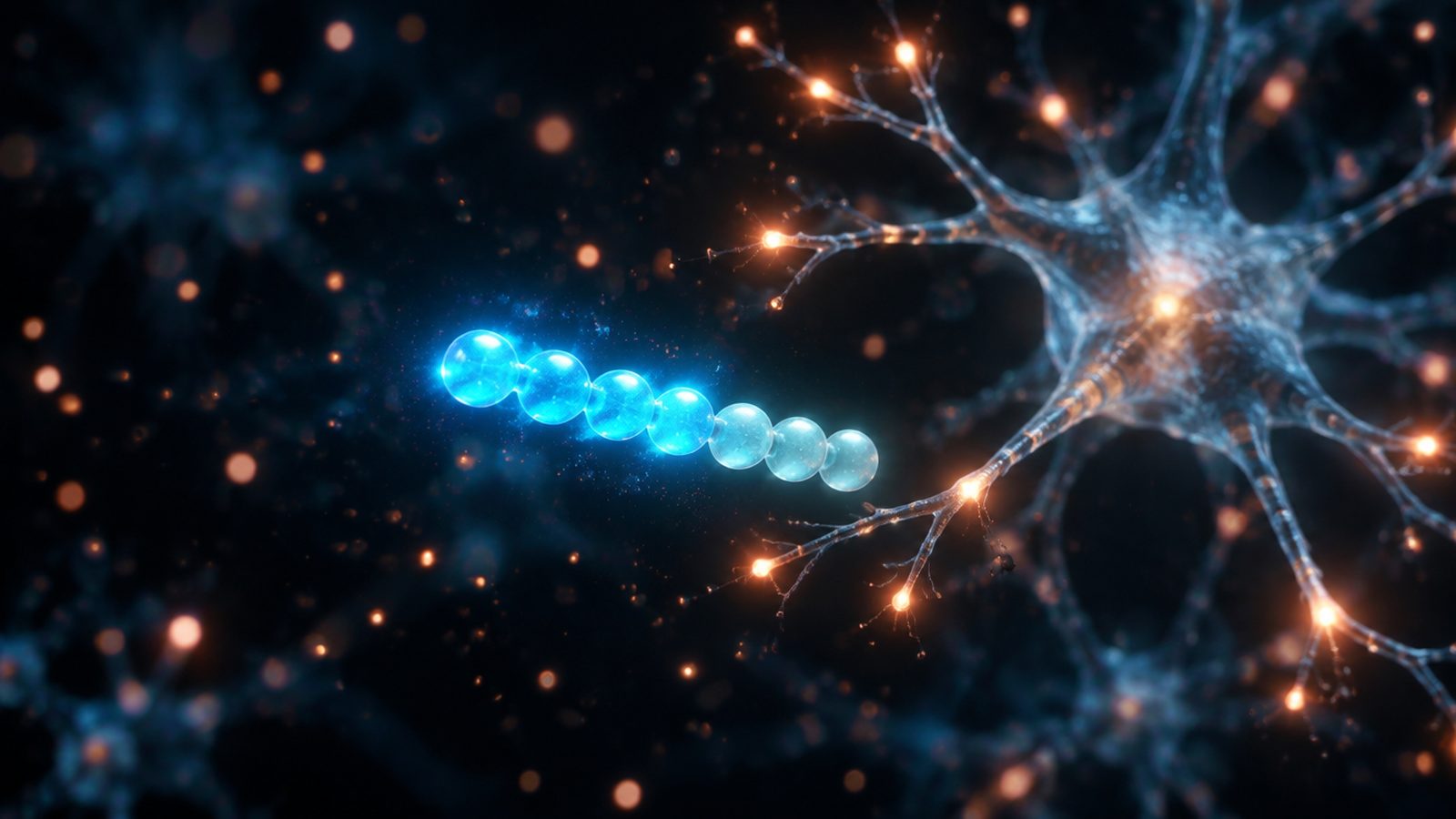
Angiotensin IV is a peptide, a short chain of amino acids. Think of amino acids as beads and a peptide as a short bead bracelet. New to this? Start with what a peptide is.
In animal studies, angiotensin IV and its cousins seemed to help memory. They break down fast, though, and have a hard time getting into the brain.
So the team got clever. They kept three beads from a version of it, then changed the ends to make it tougher. The final molecule has two of the usual beads at its core, with a small chemical cap on each end. That is why it is called peptide-like.
The team reported that dihexa held up far better and could get into the brain.
What it does in the body
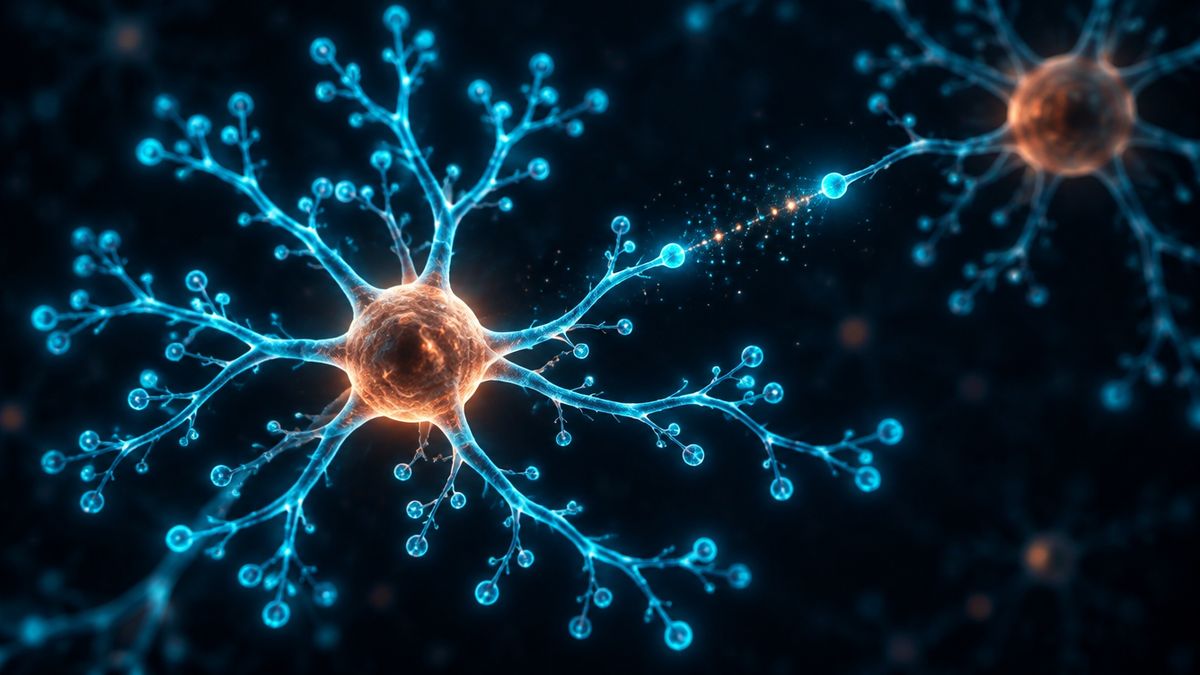
Brain cells have branches called dendrites. Along them sit tiny buds called spines. Many bridges between cells, called synapses, form on these buds. More buds can mean room for more bridges.
Dihexa seems to work through a growth signal called HGF and its partner, MET. If HGF is a key, MET is the lock on the cell. When the key turns, the cell gets the message to grow.
Scientists think dihexa helps the HGF key work better. In a 2025 rat study, a separate team found that a drug that blocks MET stopped dihexa's effect. That points neatly to the HGF and MET system.

What scientists have found
In cells:
In brain cells in a dish, dihexa raised the number of spines nearly threefold, the first team's 2013 study reported. The team also saw signs of new bridges.
In animals:
Labs outside the first team have seen exciting results, many in a memory test called the water maze. Animals swim in a pool to find a hidden resting spot.
In 2021, a lab in China tested mice bred to get Alzheimer's-like brain changes. Mice given dihexa found the hidden spot faster. They also had more of a protein found at the bridges.
In the 2025 study, rats with repeated mild head injuries did better on a memory task with dihexa. A 2024 rat study of a Huntington's-like illness saw no benefit, so researchers are still mapping where it helps.

The first team's 2013 study also reported maze gains. Rats got a drug that causes short-term memory trouble, and those given dihexa found the spot faster. So did old rats, about two years old.
In people:
Dihexa itself has no published trials in people yet. A close cousin does. It is called fosgonimeton, and the body turns it into dihexa.
In a 2024 trial, 312 people with mild to moderate Alzheimer's got fosgonimeton or a placebo for 26 weeks. A placebo is a dummy look-alike. Its maker said fosgonimeton was generally well tolerated. On the main test of thinking and daily life, it did not beat the placebo.
Where it stands
Neither dihexa nor fosgonimeton is approved by the FDA.
In 2025, a journal retracted a 2014 dihexa paper from the first team after a university review found that some of its data were falsified or made up. The 2013 paper carries a journal note of concern.
That makes the results from other labs extra important. The exciting next step is more teams repeating the cell and animal work. Researchers also want to learn if the HGF and MET system can be safely tuned in people.
It is early days, and dihexa is one to watch. For another brain peptide with a growth-signal story, see Semax.
The bottom line
- Dihexa is a lab-made, peptide-like molecule designed to help brain cells build new connections.
- In cells, it grew more spines on brain cells. Labs beyond the first team saw memory gains in mice and rats.
- In people, its cousin fosgonimeton did not beat placebo in a 2024 Alzheimer's trial. More studies from more labs are the next step.
FAQ
Questions people ask
- What is dihexa?
- Dihexa is a small, lab-made, peptide-like molecule designed to help brain cells form new connections. Washington State University scientists built it from angiotensin IV, a piece of a blood-pressure hormone.
- How does dihexa work?
- In cell and rat studies, it seems to help a growth signal called HGF and its partner, MET, tell brain cells to grow. In a 2025 rat study by a separate team, blocking MET stopped its memory effect.
- Has dihexa been tested in humans?
- Not yet in published trials of dihexa itself. Its close cousin fosgonimeton, which the body turns into dihexa, was generally well tolerated in a 2024 Alzheimer's trial of 312 people but did not beat placebo on its main test.
- Is dihexa approved by the FDA?
- No. Neither dihexa nor fosgonimeton, the related drug tested in people, is approved by the FDA.
Sources8
- Evaluation of metabolically stabilized angiotensin IV analogs as procognitive/antidementia agents · Journal of Pharmacology and Experimental Therapeutics (expression of concern published 2021), 2013 · DOI 10.1124/jpet.112.199497
- Cognitive benefits of angiotensin IV and angiotensin-(1-7): A systematic review of experimental studies · Neuroscience & Biobehavioral Reviews, 2018 · DOI 10.1016/j.neubiorev.2018.05.005
- AngIV-Analog Dihexa Rescues Cognitive Impairment and Recovers Memory in the APP/PS1 Mouse via the PI3K/AKT Signaling Pathway · Brain Sciences, 2021 · DOI 10.3390/brainsci11111487
- Hepatocyte Growth Factor/MET Activator Rescues Working Memory Deficits after Repeated Mild Traumatic Brain Injury · Neurotrauma Reports, 2025 · DOI 10.1177/2689288X251392851
- Effects of an Angiotensin IV Analog on 3-Nitropropionic Acid-Induced Huntington's Disease-Like Symptoms in Rats · Journal of Huntington's Disease, 2024 · DOI 10.3233/JHD-231507
- Athira Pharma Announces Topline Results from Phase 2/3 LIFT-AD Clinical Trial of Fosgonimeton for Mild-to-Moderate Alzheimer's Disease · Athira Pharma press release (SEC Form 8-K, Exhibit 99.1), 2024
- Athira Pharma, Inc. Annual Report (Form 10-K) for fiscal year 2023 · U.S. Securities and Exchange Commission (EDGAR), 2024
- Retraction notice to "The Procognitive and Synaptogenic Effects of Angiotensin IV-Derived Peptides Are Dependent on Activation of the Hepatocyte Growth Factor/c-Met System" [J Pharmacol Exp Ther 351 (2014) 390-402] · Journal of Pharmacology and Experimental Therapeutics, 2025 · DOI 10.1016/j.jpet.2025.103567
Education only. Not medical advice. The Cell Brief summarises published research for general education. It is not medical advice, and nothing here is a recommendation to use any compound.
One brief a week
One brief per compound. Unsubscribe anytime.