The Cell BriefBrain
DSIP: The Sleeping-Rabbit Peptide That Still Keeps Its Secrets
In 1977, scientists found a tiny peptide in the blood of sleeping rabbits. Nearly 50 years on, it is one of science's most charming mysteries.

Can sleep travel in the blood? In the 1960s, a curious team in Basel, Switzerland, set out to find out. They brought on sleep in rabbits with an electric signal to a deep part of the brain. Then they searched the blood leaving the sleeping rabbits' brains.
In 1977, they described what they found. It was a tiny peptide that seemed to bring on deep sleep in other rabbits. Nearly 50 years later, it is still one of science's most charming mysteries.
What it is
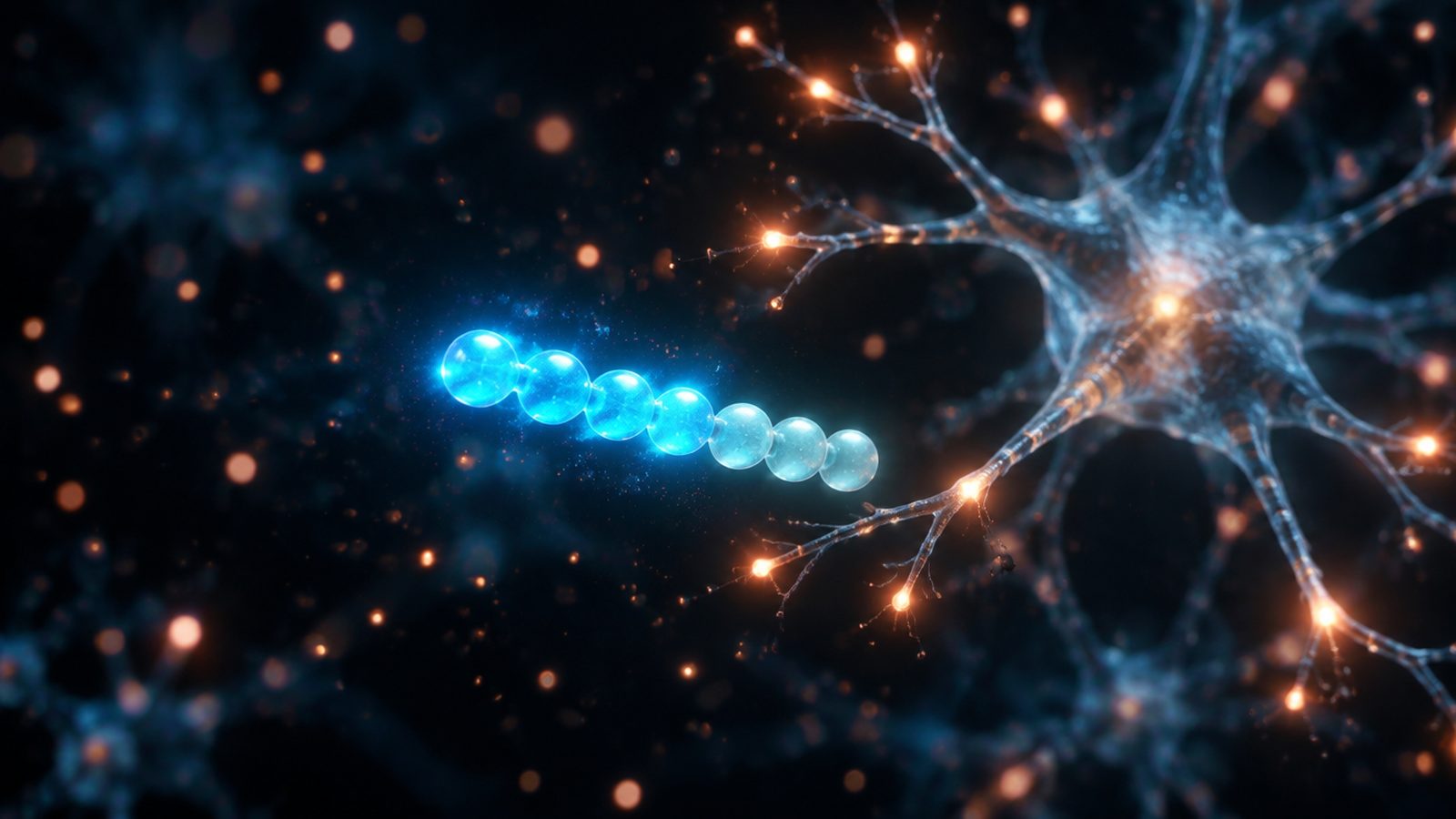
A peptide is a short chain of amino acids. Think of amino acids as beads and a peptide as a short bead bracelet. New to this? Start with what a peptide is.
The rabbit peptide is a bracelet of just nine beads. The team named it DSIP, short for delta sleep-inducing peptide.

"Delta" points to the deepest kind of sleep. While you sleep, your brain makes waves of electric activity. In the deepest stage, the waves turn big and slow, like long ocean swells.
These are delta waves. So this stage is called delta sleep, or slow-wave sleep.

What it does in the body
Here is where it gets fun. Lab tests pick up something DSIP-like in the brains of many kinds of animals. Yet the gene that makes DSIP has never been found.
A gene is like a recipe card your cells read to build things. A 2006 review called DSIP a still-unsolved riddle.
Its lock is still out there too. Many peptides work like a key that fits a lock on a cell, called a receptor. Scientists are still searching for the lock DSIP fits.
Even its bead pattern is one of a kind. It looks unlike any other known family of peptides.
So how might it work? Rat studies offer a clever clue: it may work partly through the body's own painkiller system. A 2026 FDA review said its main way of working is still an open question.
What scientists have found
In cells: In lab work on rat nerve endings, DSIP helped them release the body's natural painkillers. Curiously, in tests on rat brain tissue, it did not fit the locks those painkillers use.
In animals: In the 1977 study, the team tested DSIP and eight related peptides in 58 rabbits. The tests were "blind," so the scientists did not know which rabbit got which peptide. Only DSIP boosted the slow delta waves.

In a 1988 study, rats were kept awake for 4 hours. Afterward, they got extra deep sleep. When scientists blocked DSIP in the rats' brains, that extra deep sleep did not show up. That hints DSIP, or something like it, plays a part in deep sleep.
Some studies in cats and rats also saw longer deep sleep. Other rat studies saw no rise in delta waves, so results were mixed. One team even found man-made cousins of DSIP that helped rabbits and rats sleep deeply when DSIP itself did not. That makes the whole family a promising lead.
In people: Small studies in the 1980s tested DSIP in adults with long-lasting insomnia, or trouble sleeping. In a 1987 study of 14 adults, sleep was better on DSIP nights than on placebo nights. They were more alert in the daytime too. A placebo is a dummy look-alike.
In a 1992 study of 16 adults, the effects were weak, so results so far are mixed.
In a 1984 study, 107 hospital patients going through alcohol or opioid withdrawal got DSIP. Doctors and nurses reported that most patients' symptoms eased. There was no comparison group, so a trial with one would be the next step to learn how much came from DSIP.
Where it stands
DSIP is not FDA-approved, and a 2026 FDA review found it was not a registered drug in any country it checked.
That leaves researchers with fun questions to chase. Does the body make a DSIP-like cousin we have not met yet? What lock does it fit? Modern tools could finally crack the case.
It is a true sleep mystery, and one to watch. Curious about another brain peptide? Read about Selank.
The bottom line
- DSIP is a nine-bead peptide first described in 1977 from the blood of sleeping rabbits.
- In rabbits, it boosted the slow delta waves of deep sleep. Results in rats, cats and people have been mixed so far.
- Its gene and its lock are still waiting to be found. Modern tools could finally solve the riddle.
FAQ
Questions people ask
- What is DSIP?
- DSIP stands for delta sleep-inducing peptide. It is a short chain of nine amino acids, first described in 1977 from the blood of sleeping rabbits, and it is still a sleep-science mystery.
- What is delta sleep?
- Delta sleep is the deepest stage of sleep, when brain waves turn big and slow, like long ocean swells. It is also called slow-wave sleep.
- Is DSIP approved by the FDA?
- No. DSIP is not FDA-approved, and a 2026 FDA review found it was not a registered drug in any country it checked. For now, it is a fascinating puzzle for sleep researchers.
- Has DSIP been tested in people?
- Yes, in small studies, mostly in the 1980s. A 1987 study of 14 adults with insomnia saw better sleep on DSIP nights, while a 1992 study of 16 adults saw weak effects, so results are mixed so far.
Sources8
- Characterization of a delta-electroencephalogram (-sleep)-inducing peptide · Proceedings of the National Academy of Sciences (PNAS), 1977 · DOI 10.1073/pnas.74.3.1282
- Delta sleep-inducing peptide (DSIP): a still unresolved riddle · Journal of Neurochemistry, 2006 · DOI 10.1111/j.1471-4159.2006.03693.x
- FDA Briefing Document, Pharmacy Compounding Advisory Committee, July 23-24, 2026: Emideltide-Related Bulk Drug Substances · U.S. Food and Drug Administration, 2026
- Evidence for a role of delta sleep-inducing peptide in slow-wave sleep and sleep-related growth hormone release in the rat · Proceedings of the National Academy of Sciences (PNAS), 1988 · DOI 10.1073/pnas.85.10.3653
- The influence of synthetic DSIP (delta-sleep-inducing-peptide) on disturbed human sleep · Experientia, 1981 · DOI 10.1007/BF01971753
- Effects of delta-sleep-inducing peptide on 24-hour sleep-wake behaviour in severe chronic insomnia · European Neurology, 1987 · DOI 10.1159/000116143
- Effects of delta sleep-inducing peptide on sleep of chronic insomniac patients. A double-blind study · Neuropsychobiology, 1992 · DOI 10.1159/000118919
- DSIP in the treatment of withdrawal syndromes from alcohol and opiates · European Neurology, 1984 · DOI 10.1159/000115715
Education only. Not medical advice. The Cell Brief summarises published research for general education. It is not medical advice, and nothing here is a recommendation to use any compound.
One brief a week
One brief per compound. Unsubscribe anytime.