
The Cell BriefMetabolism
5-Amino-1MQ: The Tiny Molecule That Blocks a Fat-Cell Enzyme
A tiny lab-made molecule, not a peptide, that blocks NNMT, an enzyme plentiful in fat cells. Here is what studies in cells and mice have found so far.

Deep inside your fat cells works a tiny machine called NNMT. In 2014, scientists found that turning it down in mice kept them from getting fat on a rich diet.
So a team in Galveston, Texas, looked for a small molecule that could block it. One of the strongest was 5-amino-1MQ. In obese mice, it trimmed weight and fat. Yet the mice ate about the same amount of food.
What it is
5-amino-1MQ is not a peptide. A peptide is a short chain of amino acids, like a bead bracelet. New to this? Start with what a peptide is.
5-amino-1MQ is one small, lab-made molecule. Think of it as a single tiny charm, not a bracelet.
It earns a spot here because it works on cell energy, like many peptides we cover.
Its target, NNMT, is an enzyme. An enzyme is a tiny machine that changes other molecules. NNMT is most plentiful in fat and the liver.
What it does in the body
Cells need a helper called NAD+ to turn food into energy. They build NAD+ from vitamin B3. They also reuse B3 to make more.
Think of a recycling line. Bits of B3 ride along and get rebuilt into NAD+. NNMT pulls bits off the line and tags them, so they leave the line.
To make each tag, NNMT also uses up a second helper, called SAM.
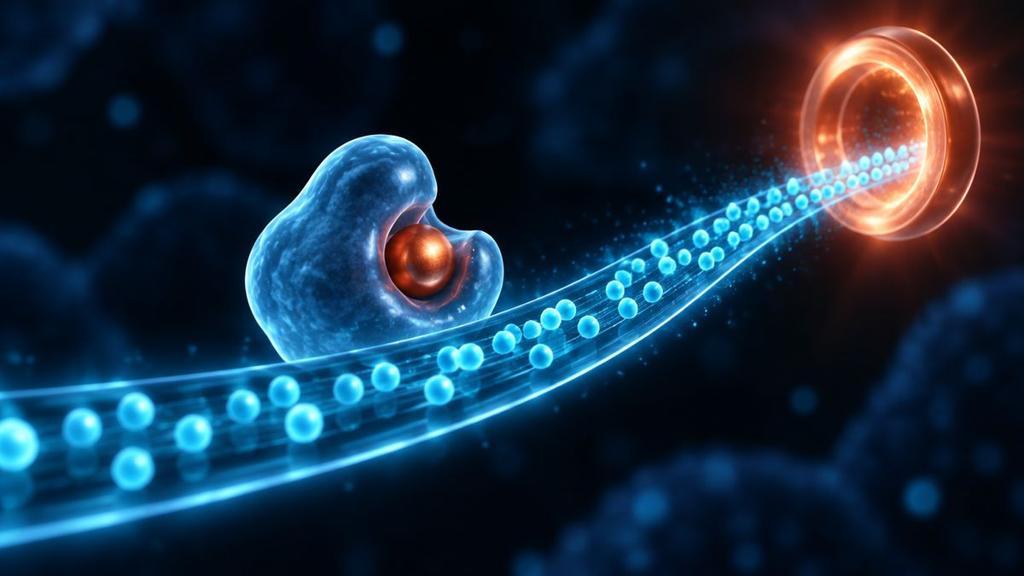
NNMT has a pocket shaped for B3. 5-amino-1MQ fits into that pocket. Like gum in a keyhole, it stops NNMT from grabbing B3.
In obese mice, fat tissue holds more NNMT than usual. That made it an exciting target.
What scientists have found
In cells: In fat cells in a dish, 5-amino-1MQ cut the tagged B3 that NNMT makes. Levels of NAD+ and SAM went up.
Young fat cells also stored less fat, up to 70% less. In tests, it left several related enzymes alone.
In muscle cells in a dish, it helped young cells grow into mature muscle cells.
In animals: The 2018 study used 18 obese male mice on a high-fat diet. Half got 5-amino-1MQ for 11 days. They lost about 5% of their body weight. The untreated mice gained a little over 1%.
Both groups ate about the same amount. In treated mice, a main fat pad weighed about 35% less. Their fat cells were over 30% smaller.

A 2024 study lasted about a month. Obese mice given more of it gained far less weight and fat, yet ate about the same. Their lean mass, the non-fat part, held steady. They handled sugar better, and their livers held less fat.
Old mice add a fun twist. NNMT builds up in muscle with age.
In 2019, two-year-old mice got a planned injury to one leg muscle. With 5-amino-1MQ, their muscle stem cells, the repair crew, were busier. Regrown fibers were nearly twice the size. The muscle was about 70% stronger than in untreated old mice.
In a 2024 study, 35 old female mice took part for eight weeks. Treated mice that did not exercise had about 40% stronger grip than untreated ones. A weighted running wheel alone gave 20%. Both together gave 60%.

In people: No human studies of 5-amino-1MQ have been published yet. A 2024 review found no documented clinical trials aimed at NNMT.
People do offer a clue. In 199 people having belly surgery, the NNMT gene in fat was about twice as active in those with type 2 diabetes. In 60 people, a 12-week exercise plan went with a less active NNMT gene in fat.
Where it stands
5-amino-1MQ is not approved by the FDA.
Most of the work so far comes from the Galveston team and its partners. Researchers want to know if the mouse results carry over to people.
They also want to map everything it touches. One lab screen found it blocked a second enzyme, too.
The exciting next step would be careful studies in people. For now, it is one to watch. For more cell-energy science, meet MOTS-c and SS-31.
The bottom line
- 5-amino-1MQ is a small molecule, not a peptide. It blocks NNMT, an enzyme plentiful in fat.
- In obese mice, it trimmed weight and fat without changing how much they ate. In old mice, it helped muscle repair and grip.
- There are no human studies yet. It is not FDA-approved, and it is one to watch.
FAQ
Questions people ask
- What is 5-amino-1MQ?
- 5-amino-1MQ is a small lab-made molecule, not a peptide. It blocks NNMT, an enzyme that is most plentiful in fat and the liver.
- Is 5-amino-1MQ FDA approved?
- No. 5-amino-1MQ is not approved by the FDA, and no human studies of it have been published yet.
- What are the side effects of 5-amino-1MQ?
- Side effects in people are not known, because no human studies have been published. In a 2018 study of obese mice, researchers reported no observable harmful effects over 11 days.
- How does 5-amino-1MQ work?
- It plugs NNMT, an enzyme that pulls vitamin B3 away from the cell's NAD+ recycling. In fat cells in a dish, this raised NAD+ and cut how much fat the cells stored.
Sources7
- Nicotinamide N-methyltransferase knockdown protects against diet-induced obesity · Nature, 2014 · DOI 10.1038/nature13198
- Selective and membrane-permeable small molecule inhibitors of nicotinamide N-methyltransferase reverse high fat diet-induced obesity in mice · Biochemical Pharmacology, 2018 · DOI 10.1016/j.bcp.2017.11.007
- Small molecule nicotinamide N-methyltransferase inhibitor activates senescent muscle stem cells and improves regenerative capacity of aged skeletal muscle · Biochemical Pharmacology, 2019 · DOI 10.1016/j.bcp.2019.02.008
- Nicotinamide N-methyltransferase inhibition mimics and boosts exercise-mediated improvements in muscle function in aged mice · Scientific Reports, 2024 · DOI 10.1038/s41598-024-66034-9
- Nicotinamide N-methyltransferase inhibition mitigates obesity-related metabolic dysfunction · Diabetes, Obesity and Metabolism, 2024 · DOI 10.1111/dom.15879
- Association of nicotinamide-N-methyltransferase mRNA expression in human adipose tissue and the plasma concentration of its product, 1-methylnicotinamide, with insulin resistance · Diabetologia, 2015 · DOI 10.1007/s00125-014-3490-7
- Nicotinamide N-methyltransferase (NNMT): a novel therapeutic target for metabolic syndrome · Frontiers in Pharmacology, 2024 · DOI 10.3389/fphar.2024.1410479
Education only. Not medical advice. The Cell Brief summarises published research for general education. It is not medical advice, and nothing here is a recommendation to use any compound.
Which peptide family should you explore first?
Answer a few questions about your everyday life. Get your peptide family, the briefs to read first, and the full list in your inbox.
Take the quiz