
The Cell BriefMetabolism
SLU-PP-332: The Molecule That Mimics a Workout in Mice
A small lab-made molecule that flips on ERRs, the master switches muscles use to adapt to exercise. Here is what studies in cells and mice have found so far.

What if a molecule could tell your muscles they had been for a run? That is the big idea behind SLU-PP-332.
In 2023, a team in St. Louis, Missouri, shared a striking result. Mice given SLU-PP-332 ran about 70% longer than untreated mice. Scientists call it an "exercise mimetic," a copycat of exercise.
What it is
SLU-PP-332 is not a peptide. A peptide is a short chain of amino acids, like a short bead bracelet. New to this? Start with what a peptide is.
SLU-PP-332 is a small, lab-made molecule, much smaller than most peptides. It belongs here because it works on the same cell parts many peptides do: the switches and power plants that run your energy.

Chemists at Saint Louis University were part of that team. The team reshaped an older molecule so it would grip its main target far better.
What it does in the body
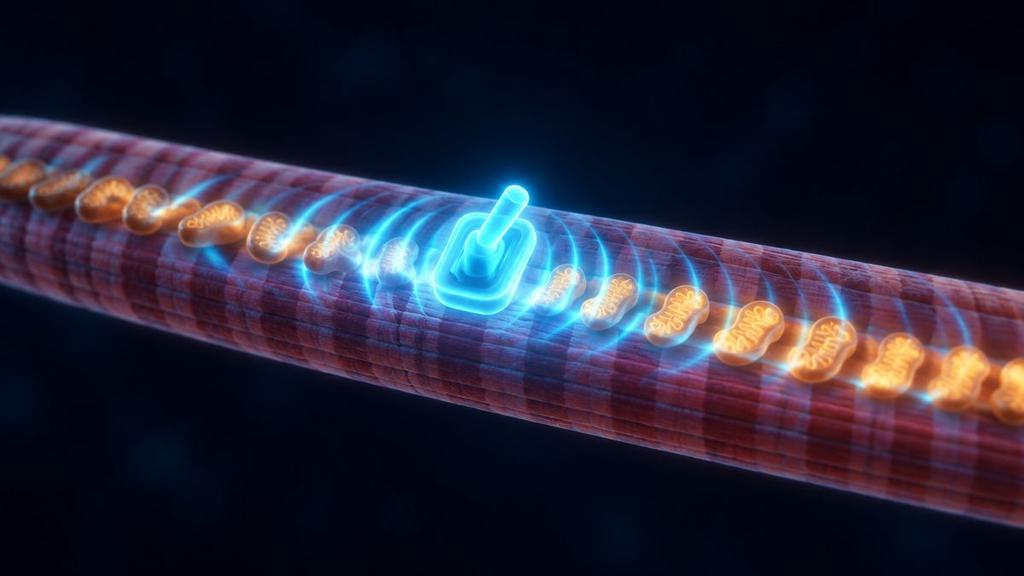
SLU-PP-332 switches on proteins called ERRs. Think of each ERR as a master switch inside a cell. Flip it, and a whole set of genes gets to work.
Many of those genes help cells burn fat and build mitochondria. Mitochondria are the cell's power plants.
ERR stands for estrogen-related receptor. ERRs look a lot like the body's estrogen sensors, but estrogen does not bind to them.
ERRs are busy where the body needs lots of energy. That includes muscle, the heart, the brain, the liver and body fat.
When you train, your muscles change. They build more power plants and get better at going the distance. ERRs help drive that change. So scientists asked a bold question: could a molecule flip these switches without the workout?
There are three ERRs. SLU-PP-332 turns on all three, but it pulls hardest on one called ERR-alpha. Drugs that switch on ERR-alpha had been very hard to make.
What scientists have found
In cells: In mouse muscle cells in a dish, SLU-PP-332 made the power plants work harder. The cells built more of them, too.
In a 2025 study from Italy, researchers grew muscle cells taken from inactive older women during hip surgery. With SLU-PP-332, the cells showed fewer signs of stress and aging. They also formed plenty of new muscle fibers.
In animals: In the 2023 study, SLU-PP-332 gave mice more endurance fibers in their muscles. These fibers are built for long efforts. After about a week of it, the mice ran about 70% longer and 45% farther than untreated mice.
In mice whose muscles lacked ERR-alpha, the running boost was gone. So that one switch seems to be the key.
Next, the team tested mice that were obese from a high-fat diet. After 28 days, treated mice weighed about 12% less than untreated ones. Untreated mice gained about 5 grams of fat. Treated mice gained less than half a gram. Both groups ate about the same and moved about the same.
Related studies looked at the heart and kidneys. In mice with a failing heart, it helped the heart pump better, and more of the mice lived. In old mice, eight weeks of it turned back several signs of kidney aging.
In people: SLU-PP-332 has not been tested in people yet. No human studies have been published, and none are listed in the U.S. trial registry.
There is a clue from people, though. In that Italian study, muscle from 10 inactive women had less ERR-alpha than muscle from 10 active women.
Where it stands
SLU-PP-332 is not approved by the FDA. Scientists use it as a lab tool to study the ERR switches.
The team has also built a cousin, SLU-PP-915. In mice, it boosted running too, even when swallowed. Anti-doping scientists are already working on ways to spot SLU-PP-332 in tests.
The exciting next step is careful studies in people. Your body makes its own exercise-linked signals, too, like the peptide MOTS-c. Another lab favorite aimed at the cell's power plants is SS-31.
The bottom line
- SLU-PP-332 is a small lab-made molecule, not a peptide. It switches on ERRs, master switches muscles use to adapt to exercise.
- In mice, it boosted running and cut fat gain on a high-fat diet, without changing how much they ate.
- It is not FDA-approved and has not been tested in people. Human studies are the exciting next step.
FAQ
Questions people ask
- What is SLU-PP-332?
- SLU-PP-332 is a small lab-made molecule that switches on ERRs, master switches muscles use to adapt to exercise. Scientists call it an exercise mimetic, a copycat of exercise.
- Is SLU-PP-332 a peptide?
- No. SLU-PP-332 is a small lab-made molecule, not a chain of amino acids like a peptide. It works on the cell's energy switches and power plants.
- Is SLU-PP-332 FDA approved?
- No. SLU-PP-332 is not approved by the FDA, and no studies of it in people have been published yet.
- What are the side effects of SLU-PP-332?
- Side effects in people are not known, because it has not been tested in people. In obese mice given it for 28 days, researchers saw no rise in liver enzymes, a common safety check.
Sources8
- Synthetic ERRα/β/γ Agonist Induces an ERRα-Dependent Acute Aerobic Exercise Response and Enhances Exercise Capacity · ACS Chemical Biology, 2023 · DOI 10.1021/acschembio.2c00720
- A Synthetic ERR Agonist Alleviates Metabolic Syndrome · Journal of Pharmacology and Experimental Therapeutics, 2024 · DOI 10.1124/jpet.123.001733
- Targeting ERRs to counteract age-related muscle atrophy associated with physical inactivity: a pilot study · Frontiers in Physiology, 2025 · DOI 10.3389/fphys.2025.1616693
- Novel Pan-ERR Agonists Ameliorate Heart Failure Through Enhancing Cardiac Fatty Acid Metabolism and Mitochondrial Function · Circulation, 2024 · DOI 10.1161/CIRCULATIONAHA.123.066542
- Estrogen-Related Receptor Agonism Reverses Mitochondrial Dysfunction and Inflammation in the Aging Kidney · The American Journal of Pathology, 2023 · DOI 10.1016/j.ajpath.2023.07.008
- An orally active estrogen receptor-related receptor agonist, SLU-PP-915, enhances aerobic exercise capacity · Journal of Pharmacology and Experimental Therapeutics, 2026 · DOI 10.1016/j.jpet.2025.103787
- Analysis and Identification of In Vitro Metabolites of Exercise Mimetic SLU-PP-332 ERRα/β/γ Agonist for Doping-Control Purposes · Drug Testing and Analysis, 2026 · DOI 10.1002/dta.70035
- ClinicalTrials.gov search results for SLU-PP-332 · ClinicalTrials.gov (U.S. National Library of Medicine), 2026
Education only. Not medical advice. The Cell Brief summarises published research for general education. It is not medical advice, and nothing here is a recommendation to use any compound.
Which peptide family should you explore first?
Answer a few questions about your everyday life. Get your peptide family, the briefs to read first, and the full list in your inbox.
Take the quiz