
The Cell BriefBasics
Peptide Blends: Why Some Peptides Are Studied in Pairs
Some peptides are studied in pairs. See why scientists team them up, what a classic 1990 growth hormone study found, and what is still an open question.

Some peptides are studied on their own. Others are studied in pairs. When two or more peptides are given together, people call it a peptide blend.
Why team them up? One of the best answers comes from growth hormone research in 1990. Two different peptides, each with its own lock, opened the same door wider together.
What a peptide blend is
A peptide is a short chain of amino acids. Think of amino acids as beads and a peptide as a short bead bracelet.
A peptide blend is two or more of these bracelets given together. Scientists call it a combination. Each peptide keeps its own shape and its own job.

So the big question for any blend is simple. Does the pair do more than each one alone?
Sometimes the answer is a fun surprise. The pair does more than the two added up. Scientists call this synergy. Think of one plus one making three.
Why scientists pair peptides
Cells carry receptors on their surface. A receptor is like a lock, and a peptide is the key.
Growth hormone is made in the pituitary, a pea-sized gland under the brain. Its cells carry two different locks. Both tell the gland to let out growth hormone.
One lock answers GHRH, the brain's growth hormone signal. Sermorelin is a lab-made copy of it.
The other lock answers ghrelin, a hormone the body makes. Ipamorelin is a lab-made key for this lock. So is an older six-bead peptide called GHRP-6.
In rat pituitary cells in a dish, GHRH and GHRP-6 used separate locks. They also sent separate signals inside the cell. Together, they made the cells let out more growth hormone than the two added up.
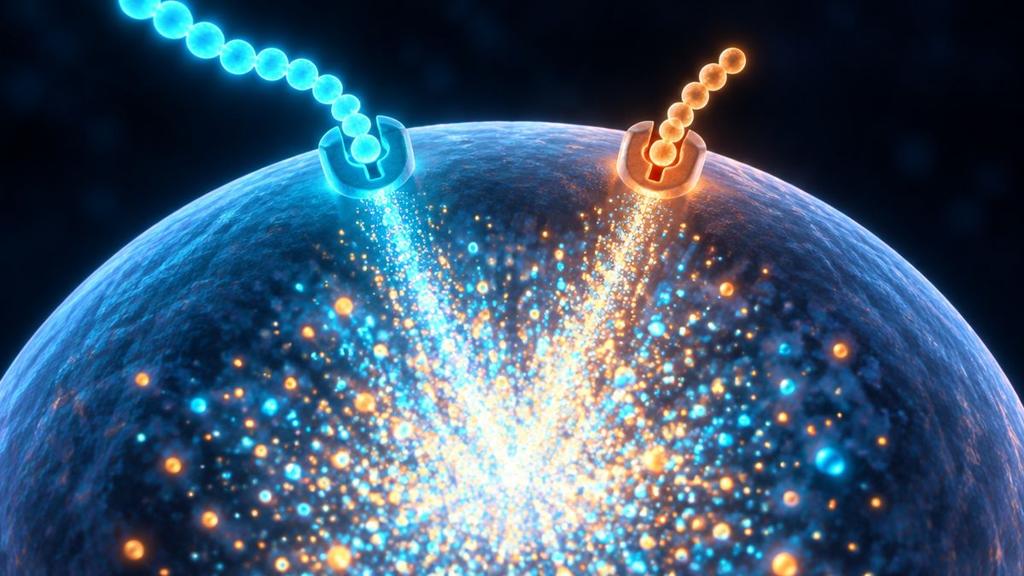
That is the big idea behind pairing. Two keys, two locks, one door opening wider.
What studies have found
In animals: A good pair study tests each peptide alone, both together, and neither. A 2026 study in 32 rats did exactly that.
The rats had an Achilles tendon cut and then repaired. That is the big cord above the heel. For four weeks, they got BPC-157, TB-500, both, or neither.
Each peptide alone showed signs of better healing, most clearly TB-500. The pair did no better than each one alone. The team thinks the two may share paths inside cells. That is a fun puzzle for the next study.
In people: The classic study came in 1990. In 18 healthy men, scientists tested GHRH, GHRP-6 and the two together.
On its own, GHRP-6 was a strong trigger for growth hormone. At lower amounts of GHRP-6, the pair released more growth hormone than the two added up.
No harmful effects were seen from GHRP-6. After GHRH, 16 of the 18 men had a mild face flush that lasted 1 to 3 minutes.

In 2001, a team in Japan tried ghrelin itself with GHRH. In healthy men, small amounts of ghrelin plus GHRH again beat the two added up.
Pairs are studied for weight, too. A 2023 trial had 92 adults with type 2 diabetes and extra weight. For 32 weeks, they got cagrilintide, semaglutide, or both. Type 2 diabetes means blood sugar runs too high.
Cagrilintide copies amylin, a hormone that helps you feel full. Semaglutide fits a different lock, the one for a hormone called GLP-1. On average, weight fell 15.6% with the pair, 5.1% with semaglutide and 8.1% with cagrilintide.
Where it stands
Some pairs have become real medicines. For example, a mix of long-acting insulin and liraglutide, a GLP-1 copy, has been FDA-approved since 2016. It is for adults with type 2 diabetes.
Most pairings have not been tested together yet. Pairs of newer lab-made growth hormone keys have few careful studies in people so far. Each peptide may have its own studies, but the pair is a brand-new question. Will the two add up, multiply, or overlap?
Careful studies that test each peptide alone and together are the exciting next step.
The bottom line
- A peptide blend is two or more peptides given together. Scientists test whether the pair does more than each one alone.
- In 18 healthy men in 1990, GHRH plus GHRP-6 released more growth hormone than the two added up. Two keys, two locks, one door opening wider.
- Some pairs became medicines, like insulin with a GLP-1 copy. Most pairings are still waiting to be tested together.
FAQ
Questions people ask
- What is a peptide blend?
- A peptide blend is two or more peptides given together. Scientists call it a combination, and they test whether the pair does more than each peptide alone.
- Why are some peptides studied in pairs?
- Two peptides that fit different locks can push toward the same goal. In a 1990 study of 18 healthy men, GHRH plus GHRP-6 released more growth hormone than the two added up.
- Are peptide blends FDA approved?
- Some peptide pairs are part of FDA-approved medicines, such as a mix of long-acting insulin and the GLP-1 copy liraglutide, approved in 2016. Most other pairings have not been tested together yet.
- What are the side effects of peptide blends?
- They depend on each peptide in the mix. In the 1990 study, 16 of 18 men had a mild face flush for 1 to 3 minutes after GHRH, and in a 2023 trial pairing cagrilintide and semaglutide, mild or moderate gut side effects were most common.
Sources8
- Growth hormone (GH)-releasing peptide stimulates GH release in normal men and acts synergistically with GH-releasing hormone · Journal of Clinical Endocrinology and Metabolism, 1990 · DOI 10.1210/jcem-70-4-975
- The synergistic effects of His-D-Trp-Ala-Trp-D-Phe-Lys-NH2 on growth hormone (GH)-releasing factor-stimulated GH release and intracellular adenosine 3',5'-monophosphate accumulation in rat primary pituitary cell culture · Endocrinology, 1989 · DOI 10.1210/endo-124-6-2791
- A low dose of ghrelin stimulates growth hormone (GH) release synergistically with GH-releasing hormone in humans · Journal of Clinical Endocrinology and Metabolism, 2001 · DOI 10.1210/jcem.86.9.8002
- Amylin: From Mode of Action to Future Clinical Potential in Diabetes and Obesity · Diabetes Therapy, 2025 · DOI 10.1007/s13300-025-01733-8
- Effects of BPC-157 and TB-500 on Achilles tendon healing in rats: A histopathological and biomechanical study · Joint Diseases and Related Surgery, 2026 · DOI 10.52312/jdrs.2026.2951
- Efficacy and safety of co-administered once-weekly cagrilintide 2.4 mg with once-weekly semaglutide 2.4 mg in type 2 diabetes: a multicentre, randomised, double-blind, active-controlled, phase 2 trial · The Lancet, 2023 · DOI 10.1016/S0140-6736(23)01163-7
- Insulin degludec and liraglutide injection: Prescribing Information · DailyMed (U.S. National Library of Medicine), Novo Nordisk label, 2025
- The emerging landscape of performance-enhancing peptides modulating GH-IGF1 axis: bridging the gap between clinical evidence and patient self-administration · Frontiers in Endocrinology, 2026 · DOI 10.3389/fendo.2026.1822475
Education only. Not medical advice. The Cell Brief summarises published research for general education. It is not medical advice, and nothing here is a recommendation to use any compound.
Which peptide family should you explore first?
Answer a few questions about your everyday life. Get your peptide family, the briefs to read first, and the full list in your inbox.
Take the quiz