The Cell BriefMetabolism
Cagrilintide: A Long-Lasting Copy of Amylin, Insulin's Quiet Partner
Cagrilintide is a lab-made, long-lasting copy of amylin, a fullness hormone made right next to insulin. Meet its clever design and what studies have found.

Every time you eat, your pancreas lets out insulin. But insulin does not travel alone. A quiet partner rides along with it. Its name is amylin, and one of its jobs is to help you feel full.
Scientists have built a long-lasting copy of amylin, called cagrilintide. Big trials in people are testing it now.
What it is
A peptide is a short chain of amino acids. Think of amino acids as beads and a peptide as a short bead bracelet. New to this? Start with what a peptide is.
Amylin is a bracelet of 37 beads. It is made in the islets of the pancreas. Islets are tiny islands of cells. The same cells make amylin and insulin, and let both out after a meal.
Amylin was found in 1987, hiding in clumps in the pancreas of people with type 2 diabetes.
That made amylin tricky to copy. It clumps, and it wears off in under 20 minutes.
The fix came from rats. Scientists swapped in three beads from rat amylin. The new copy, called pramlintide, does not clump.
It became a diabetes medicine. But it still wore off fast.

Cagrilintide starts from the pramlintide bead pattern. Its makers swapped two more beads to fight clumping. Then they added a fatty tail.
The goal was a long-lasting copy that does not clump. It was designed for once-a-week use.
What it does in the body
Each hormone works through a receptor on cells. A receptor is a lock, and the peptide is the key.
Amylin's lock comes in two parts. The main part is called the calcitonin receptor. A small helper piece snaps onto it. There are three helper pieces, so there are three amylin locks.
Cagrilintide fits all three amylin locks. It also fits the lone calcitonin lock.
Amylin's main target is a spot in the brainstem, at the base of the brain. That spot helps you feel full.
After a meal, amylin has several jobs. It helps you feel full. It slows how fast the stomach empties. And it holds back glucagon, a hormone that raises blood sugar.

Cagrilintide works in a different way from GLP-1 drugs, which copy a gut hormone. So scientists paired it with semaglutide, a long-lasting GLP-1 copy. The pair is called CagriSema.
What scientists have found
In cells: Scientists froze cagrilintide in its locks and took super-close 3D pictures. It sat in all three amylin locks and the calcitonin lock. Each lock was in its "on" shape.
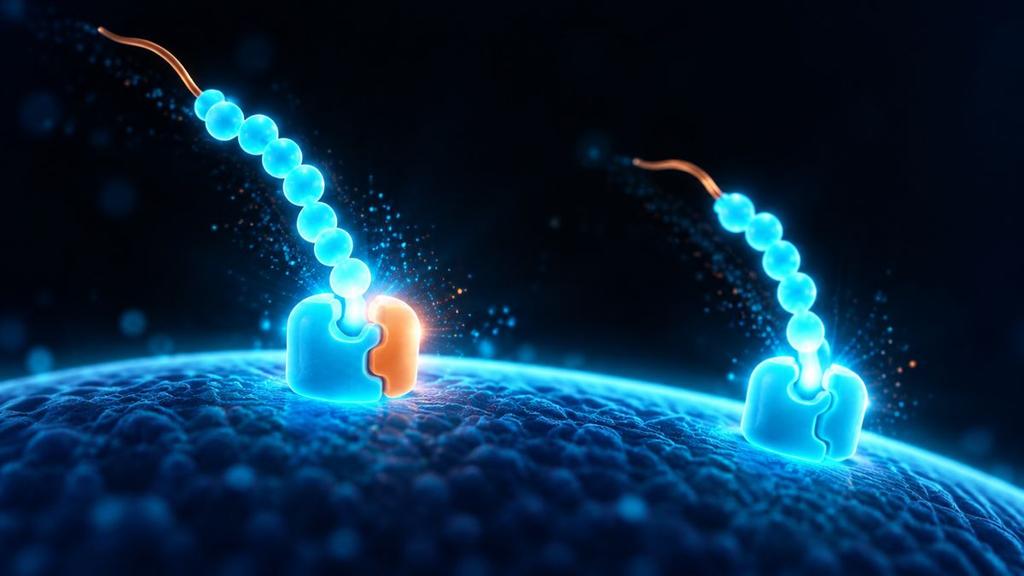
In lab-grown cells, it turned on the calcitonin lock, both alone and with a helper.
In animals: Mice ate a high-fat diet, then got cagrilintide for three weeks. On day one, they ate less than half as much as untreated mice. Their weight dropped and stayed lower. The weight they lost came from fat.
In these mice, it also switched on nerve cells in the brainstem's fullness spot. In mice missing two of the helper pieces, it worked less well.
In people: A 2021 trial followed 706 adults with extra weight for 26 weeks. Weight fell 6.0% to 10.8% on cagrilintide, depending on the dose. On placebo, a dummy look-alike, it fell 3.0%.
Then came REDEFINE 1, a trial of 3,417 adults with extra weight but no diabetes. For 68 weeks, they got cagrilintide plus semaglutide, either one alone, or placebo.
With the pair, weight fell 20.4% on average. On placebo, it fell 3.0%. A closer look at the 302 people on cagrilintide alone found their weight fell 11.5%.
The most common side effects were in the gut, like nausea, vomiting, diarrhea and constipation. Most were short-lived and mild to moderate.
Where it stands
Cagrilintide is not approved by the FDA yet.
In December 2025, its maker, Novo Nordisk, asked the FDA to approve CagriSema. Its FDA review is expected in 2026.
Cagrilintide alone now has its own big trials, called RENEW. They are the exciting next step. Researchers want to see how far it can go on its own.
The bottom line
- Cagrilintide is a long-lasting, lab-made copy of amylin, a fullness hormone made next to insulin.
- Its design borrows beads from rats, swaps two more and adds a fatty tail, to help it last and not clump.
- In a big trial in adults, weight fell 11.5% on cagrilintide alone and 20.4% with semaglutide. It is not FDA-approved yet.
FAQ
Questions people ask
- What is cagrilintide?
- Cagrilintide is a lab-made, long-lasting copy of amylin, a 37-amino-acid hormone made next to insulin in the pancreas. It fits amylin's receptors, or locks, and the related calcitonin lock.
- Is cagrilintide FDA approved?
- No, not yet. Paired with semaglutide as CagriSema, it was sent to the FDA for approval in December 2025, with the review expected in 2026.
- What are the side effects of cagrilintide?
- In trials, the most common side effects were in the gut, such as nausea, vomiting, diarrhea and constipation, and most were mild to moderate. Injection-site reactions were also common in a 2021 trial.
- Cagrilintide vs semaglutide: what is the difference?
- Cagrilintide copies amylin, a hormone from the pancreas, while semaglutide copies GLP-1, a gut hormone. Paired as CagriSema in a 68-week trial, weight fell 20.4% on average, versus 3.0% on placebo.
Sources8
- Purification and characterization of a peptide from amyloid-rich pancreases of type 2 diabetic patients · Proceedings of the National Academy of Sciences of the USA, 1987 · DOI 10.1073/pnas.84.23.8628
- Amylin: From Mode of Action to Future Clinical Potential in Diabetes and Obesity · Diabetes Therapy, 2025 · DOI 10.1007/s13300-025-01733-8
- Structural and dynamic features of cagrilintide binding to calcitonin and amylin receptors · Nature Communications, 2025 · DOI 10.1038/s41467-025-58680-y
- Cagrilintide lowers bodyweight through brain amylin receptors 1 and 3 · eBioMedicine, 2025 · DOI 10.1016/j.ebiom.2025.105836
- Once-weekly cagrilintide for weight management in people with overweight and obesity: a multicentre, randomised, double-blind, placebo-controlled and active-controlled, dose-finding phase 2 trial · The Lancet, 2021 · DOI 10.1016/S0140-6736(21)01751-7
- Coadministered Cagrilintide and Semaglutide in Adults with Overweight or Obesity (REDEFINE 1) · New England Journal of Medicine, 2025 · DOI 10.1056/NEJMoa2502081
- Novo Nordisk presents phase 3 data for next-generation amylin cagrilintide, leading to advancement into dedicated clinical programme · Novo Nordisk A/S company announcement (GlobeNewswire), 2025
- Novo Nordisk files for FDA approval of CagriSema, the first once-weekly combination of GLP-1 and amylin analogues for weight management · Novo Nordisk press release (PR Newswire), 2025
Education only. Not medical advice. The Cell Brief summarises published research for general education. It is not medical advice, and nothing here is a recommendation to use any compound.
Which peptide family should you explore first?
Answer a few questions about your everyday life. Get your peptide family, the briefs to read first, and the full list in your inbox.
Take the quiz