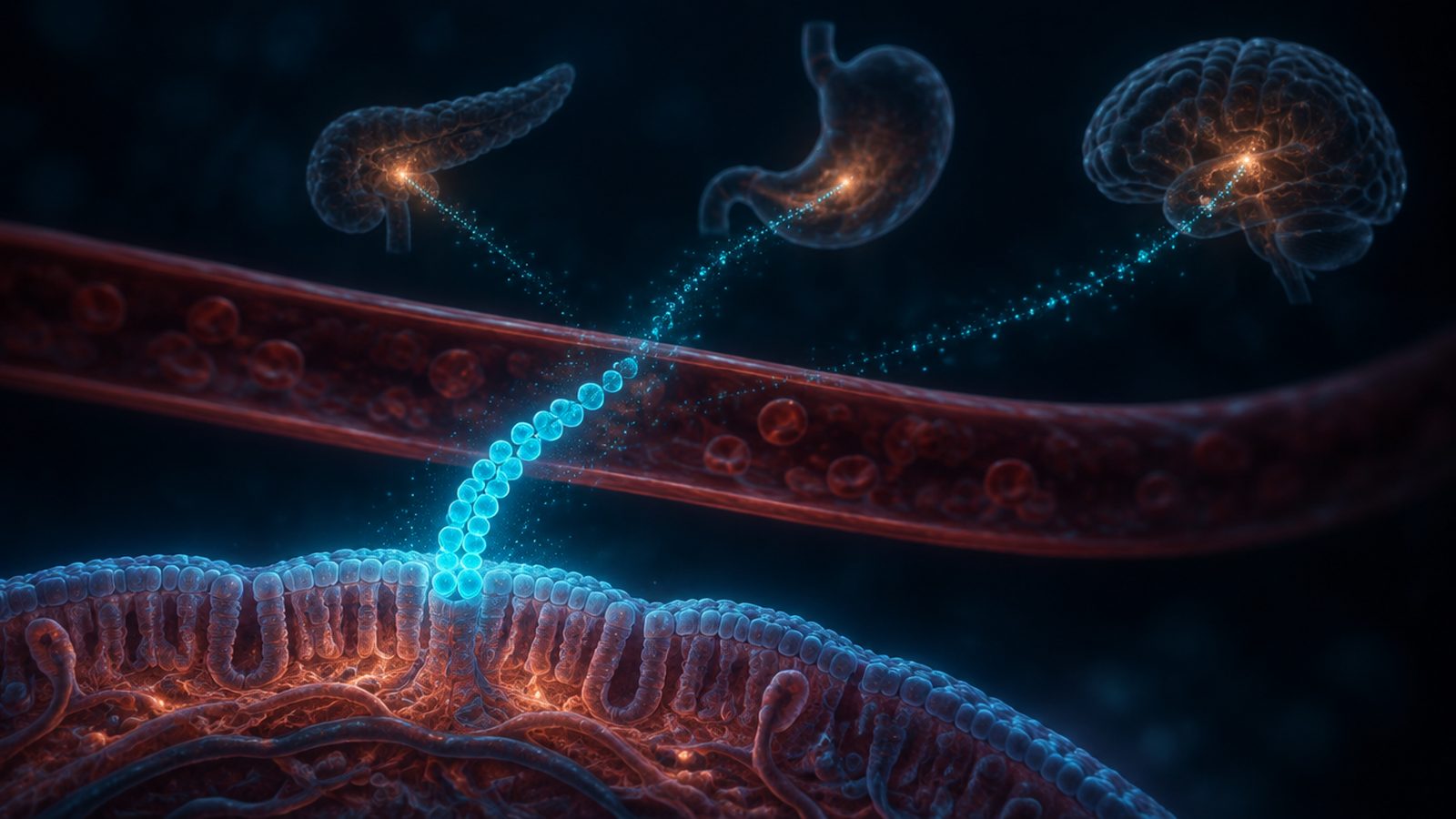
The Cell BriefMetabolism
AOD-9604: The Peptide That Kept One Chapter of Growth Hormone
Australian scientists kept one small chapter of growth hormone and set the rest aside. Meet the clever idea, and the joint research in rabbits.

Growth hormone is famous for helping children grow. It also has a second job: it helps the body break down stored fat.
So scientists in Australia had a clever idea. What if they kept one chapter of growth hormone's story, the fat chapter, and left the growth chapters behind? Their answer was a tiny peptide called AOD-9604.
What it is
A peptide is a short chain of amino acids. Think of amino acids as beads, and a peptide as a short bead bracelet. New to this? Start with what a peptide is.
Growth hormone is a much longer chain. It has 191 beads. It is made in the pituitary, a small gland under the brain.
Think of growth hormone as a long book. Different chapters seem to do different jobs. The last chapter holds much of the fat-burning part.
In 1994, a team at Monash University in Australia applied for a patent on that last chapter. It is beads 177 to 191, the final 15 beads.

Later, one extra bead was added to the front to make the chain sturdier. That 16-bead version is AOD-9604. It is like keeping one favorite chapter from a big book.
What it does in the body
Growth hormone sends many messages. One goes to the liver. It tells the liver to make IGF-1, a strong growth signal.
Lots of extra growth hormone over a long time can also push blood sugar up.
AOD-9604 was designed to sidestep all that. It keeps the fat chapter but leaves out the parts that switch on growth.
A receptor is like a lock on a cell, and a hormone is the key. Growth hormone needs its whole shape to open its lock. AOD-9604 is a small piece of that key.
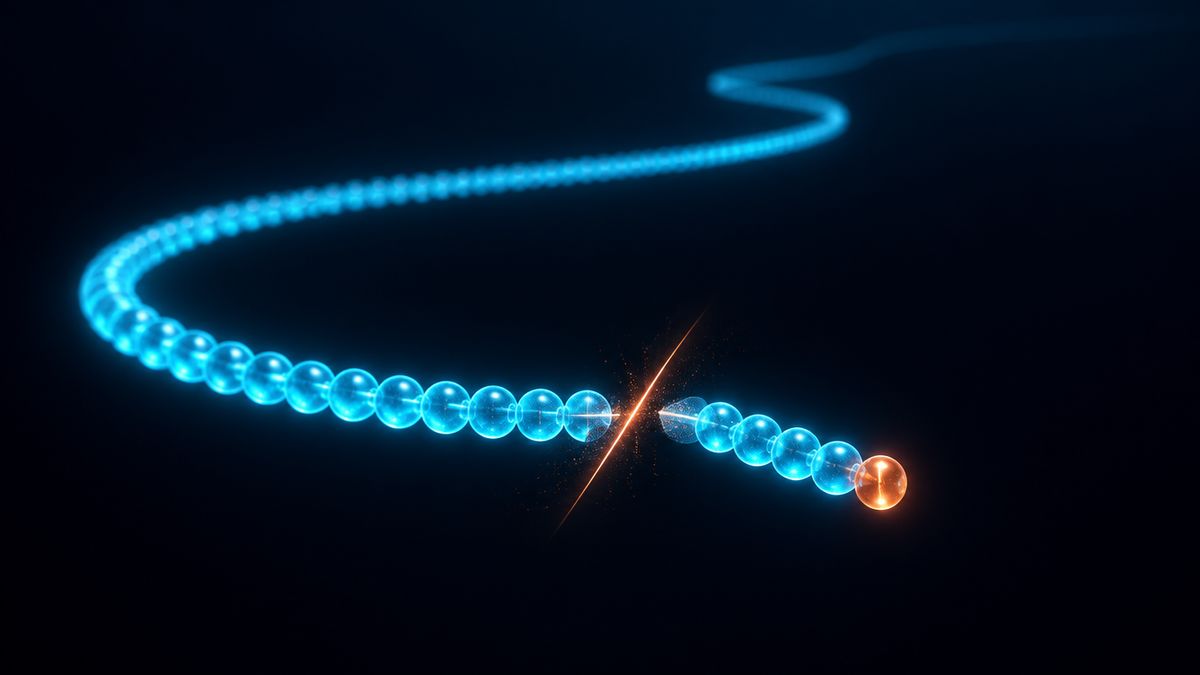
So how does it work? In animals, it seemed to act on fat itself. It helped fat cells break down stored fat so the body could burn it for fuel.
What scientists have found
In cells: Scientists tested cells that carry the growth hormone lock. Growth hormone grabbed the lock and made the cells multiply. AOD-9604 did neither, just as its designers hoped.
In animals: A 2015 study opened an exciting new path: joints. Rabbits with damaged knee cartilage, the smooth cushion at the ends of bones, got AOD-9604 right into the knee. Their cartilage looked healthier than in rabbits given salt water. They limped for a shorter time, too. Pairing it with hyaluronic acid, a slippery substance found in joints, worked even better.

The fat idea shone in rodents, too. In obese rats, AOD-9604 given by mouth for 19 days cut weight gain by more than half. Their fat tissue broke down fat faster. Their response to insulin, the body's signal to clear sugar from the blood, stayed normal.
In obese mice, two weeks of AOD-9604 slowed weight gain and raised fat burning. Unlike growth hormone, it did not push blood sugar up.
In people: Between 2001 and 2006, about 900 adults took part in six trials. Most had obesity. Each trial compared AOD-9604 with a placebo, a dummy look-alike.
Just as designed, AOD-9604 did not raise IGF-1, the growth signal, and blood sugar control held steady. Overall, side effects looked much like those on the placebo.
What about weight? In a 12-week trial of 300 adults, one AOD-9604 group lost about 2.6 kilograms, almost 6 pounds. The placebo group lost about 0.8 kilograms.
A bigger 24-week trial with more than 500 people did not find a clear difference in weight, and the weight program ended in 2007.
Researchers then explored a fresh path: joints. So far, that work comes from animals.
Where it stands
AOD-9604 is not approved by the FDA. It is on the World Anti-Doping Agency's prohibited list.
Its story shows how science moves. A clever idea shone in rats and mice, and results in people were mixed. The exciting next step is joint studies in people. Curious about another fat-and-sugar messenger? Read about GLP-1.
The bottom line
- AOD-9604 keeps one chapter of growth hormone's story: a 16-bead piece from its tail end, first developed in Australia.
- In rats and mice, it slowed weight gain without pushing blood sugar up. In rabbits with damaged knees, cartilage looked healthier.
- In about 900 adults, it left the growth signal IGF-1 unchanged, and weight results were mixed. The joint research is one to watch.
FAQ
Questions people ask
- What is AOD-9604?
- AOD-9604 is a lab-made peptide of 16 amino acids, first developed in Australia. It is the last 15 amino acids of human growth hormone, plus one extra at the front.
- Is AOD-9604 the same as growth hormone?
- No. It is a small piece of growth hormone's tail end, kept on purpose. In lab cells, it did not latch onto growth hormone's receptor, and in human trials it did not raise IGF-1, a growth signal.
- What did human trials of AOD-9604 find?
- Across six trials in about 900 adults, it did not raise IGF-1, and side effects looked much like placebo. In a 12-week trial, one group lost about 2.6 kilograms versus 0.8 on placebo. A bigger 24-week trial did not find a clear difference in weight.
- Is AOD-9604 approved by the FDA?
- AOD-9604 has been tested in six human trials and in animal joint studies. It is not approved by the FDA.
Sources8
- Treatment of obesity (US Patent 5,869,452; peptide of human growth hormone residues 177-191) · Monash University (original assignee), via Google Patents, 1999
- Metabolic studies of a synthetic lipolytic domain (AOD9604) of human growth hormone · Hormone Research, 2000 · DOI 10.1159/000053183
- Increase of fat oxidation and weight loss in obese mice caused by chronic treatment with human growth hormone or a modified C-terminal fragment · International Journal of Obesity, 2001 · DOI 10.1038/sj.ijo.0801740
- Safety and Tolerability of the Hexadecapeptide AOD9604 in Humans · Journal of Endocrinology and Metabolism, 2013 · DOI 10.4021/jem157w
- Obesity Pharmacotherapy: Current Perspectives and Future Directions · Current Cardiology Reviews, 2013 · DOI 10.2174/1573403X11309010006
- The emerging landscape of performance-enhancing peptides modulating GH-IGF1 axis: bridging the gap between clinical evidence and patient self-administration · Frontiers in Endocrinology, 2026 · DOI 10.3389/fendo.2026.1822475
- Effect of Intra-articular Injection of AOD9604 with or without Hyaluronic Acid in Rabbit Osteoarthritis Model · Annals of Clinical and Laboratory Science, 2015
- 2026 Prohibited List (Anti-Doping Convention ETS No. 135, amendment to the appendix), official publication of the World Anti-Doping Agency list · Tractatenblad van het Koninkrijk der Nederlanden (Dutch official treaty gazette), 2026 no. 25, 2026
Education only. Not medical advice. The Cell Brief summarises published research for general education. It is not medical advice, and nothing here is a recommendation to use any compound.
One brief a week
One brief per compound. Unsubscribe anytime.