The Cell BriefMetabolism
Meet Tirzepatide: One Peptide Key, Two Gut-Hormone Locks
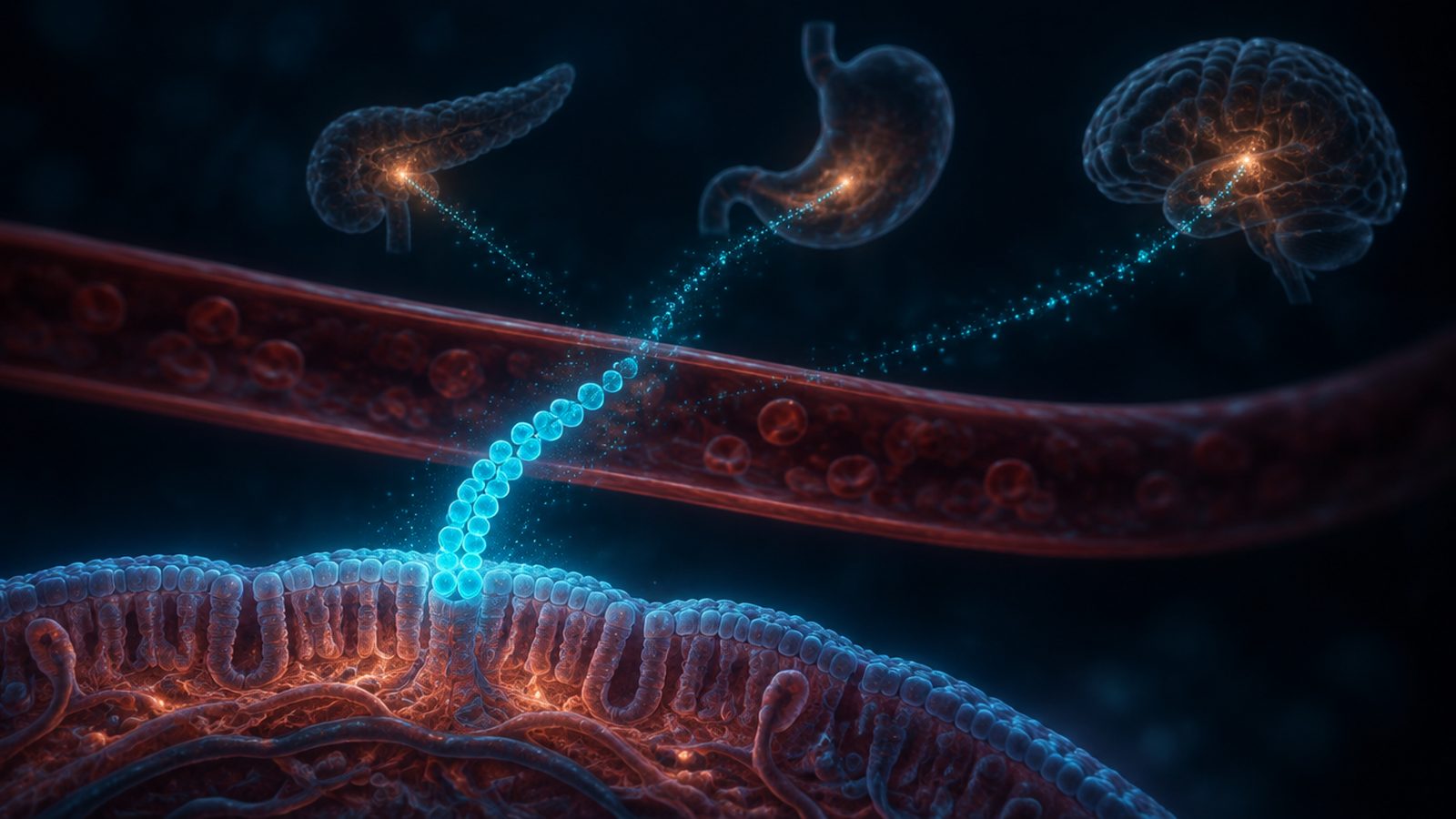
One lab-made peptide that answers to two gut-hormone signals, GIP and GLP-1. Meet the clever design and the striking trial results behind it.

After you eat, your gut sends out two short messages. One is called GLP-1. The other is called GIP.
For years, medicines like this copied GLP-1 alone. Then scientists had a bold idea: what if one molecule could send both messages at once? Their answer was tirzepatide, one of the biggest peptide success stories yet.
What it is
A peptide is a short chain of amino acids. Think of amino acids as beads and a peptide as a short bead bracelet. New to this? Start with what a peptide is.
GIP and GLP-1 are two peptides made in your gut. Both are released within minutes of a meal. Both tell the pancreas to let out insulin, the signal that pulls sugar out of the blood.

Tirzepatide is a lab-made bracelet of 39 beads. Here is the clever part. Its bead pattern is based on GIP, yet it was built to work on the GLP-1 side too.
You may know it as Mounjaro or Zepbound. Both contain tirzepatide, approved for different uses.
What it does in the body
Each hormone works through a receptor on cells. A receptor is a lock, and the peptide is the key.
GIP has its own lock. GLP-1 has a different one. Tirzepatide is one elegant key that fits both.
In people with type 2 diabetes, it helps the pancreas let out more insulin and less glucagon. Glucagon is a hormone that raises blood sugar. This happens mainly when blood sugar is high.
It also lowers how much they eat and slows how fast the stomach empties.
Natural GIP and GLP-1 do not last, because an enzyme called DPP-4 chops them up fast.
Tirzepatide has a smart fix: a fatty tail. The tail grabs albumin, a big protein that floats in the blood. Almost all of it rides on albumin, like a passenger on a raft.
Half of it is still in the blood about five days later. That is why it was designed as a once-a-week medicine.

What scientists have found
In cells: Scientists tested it in human cells built to carry one lock or the other. It turned on both locks, just as designed. It pressed the GIP lock about as hard as GIP itself, and the GLP-1 lock more gently.

In animals: In obese mice, it led to more weight loss than semaglutide, a GLP-1-only medicine. The loss was mostly fat. A long-lasting GIP copy on its own did not change their weight.
In people: The big human trials brought striking results. The SURPASS trials tested it in type 2 diabetes. In one, 1,879 adults got tirzepatide or semaglutide for 40 weeks. Tirzepatide lowered a long-term blood sugar score more, at every dose tested. Weight fell more, too.
Then came SURMOUNT-1, published in 2022. It followed 2,539 adults for 72 weeks. They had obesity, or extra weight plus a related health problem. None had diabetes. They got tirzepatide or a placebo, a dummy look-alike.
On average, weight fell 15% to 21% on tirzepatide, depending on the dose. On placebo, it fell 3%. Most side effects were in the gut and mild to moderate.
In 2025 came a head-to-head match with semaglutide, called SURMOUNT-5. The trial had 751 adults with obesity but no type 2 diabetes. After 72 weeks, weight fell 20.2% on tirzepatide and 13.7% on semaglutide.
Where it stands
Tirzepatide has been an FDA-approved medicine since 2022, first as Mounjaro for type 2 diabetes.
In 2023, as Zepbound, it was approved for long-term weight management. That is for adults with obesity, or extra weight plus a related condition. In 2024, Zepbound was approved for moderate to severe sleep apnea in adults with obesity. In sleep apnea, the airway gets blocked and breathing pauses during sleep.
Mounjaro's label now covers some children 10 and older with type 2 diabetes, too.
One fun puzzle remains. What does the GIP lock add, since GIP alone did not change weight in mice? Cracking that is the exciting next step. The story began with GLP-1.
The bottom line
- Tirzepatide is one clever 39-amino-acid peptide built to fit two gut-hormone locks, GIP and GLP-1.
- A fatty tail lets it ride on albumin, a blood protein, so it lasts days instead of minutes.
- FDA-approved since 2022, it beat semaglutide on weight in head-to-head trials. What the GIP lock adds is the next big question.
FAQ
Questions people ask
- What is tirzepatide?
- Tirzepatide is a lab-made peptide, a chain of 39 amino acids, cleverly built to fit the receptors, or locks, for two gut hormones, GIP and GLP-1.
- Are Mounjaro and Zepbound the same thing?
- Yes, both contain tirzepatide. Mounjaro has been FDA-approved since 2022 for type 2 diabetes, and Zepbound since 2023 for long-term weight management, plus sleep apnea in adults with obesity since 2024.
- How is tirzepatide different from semaglutide?
- Tirzepatide fits both the GIP and GLP-1 locks, while semaglutide fits only the GLP-1 lock. In a 72-week trial of 751 adults with obesity, weight fell 20.2% on tirzepatide and 13.7% on semaglutide.
- Why does tirzepatide last so long in the body?
- Thanks to a fatty tail, it rides on albumin, a big blood protein. Half of it is still in the blood about five days later.
Sources8
- Biology of incretins: GLP-1 and GIP · Gastroenterology, 2007 · DOI 10.1053/j.gastro.2007.03.054
- LY3298176, a novel dual GIP and GLP-1 receptor agonist for the treatment of type 2 diabetes mellitus: From discovery to clinical proof of concept · Molecular Metabolism, 2018 · DOI 10.1016/j.molmet.2018.09.009
- Tirzepatide versus Semaglutide Once Weekly in Patients with Type 2 Diabetes (SURPASS-2) · New England Journal of Medicine, 2021 · DOI 10.1056/NEJMoa2107519
- Tirzepatide Once Weekly for the Treatment of Obesity (SURMOUNT-1) · New England Journal of Medicine, 2022 · DOI 10.1056/NEJMoa2206038
- Tirzepatide as Compared with Semaglutide for the Treatment of Obesity (SURMOUNT-5) · New England Journal of Medicine, 2025 · DOI 10.1056/NEJMoa2416394
- FDA Approves New Medication for Chronic Weight Management · U.S. Food and Drug Administration, 2023
- FDA Approves First Medication for Obstructive Sleep Apnea · U.S. Food and Drug Administration, 2024
- MOUNJARO (tirzepatide) injection: Prescribing Information · DailyMed (U.S. National Library of Medicine), Eli Lilly and Company label, 2026
Education only. Not medical advice. The Cell Brief summarises published research for general education. It is not medical advice, and nothing here is a recommendation to use any compound.
One brief a week
One brief per compound. Unsubscribe anytime.