The Cell BriefMetabolism
Meet Retatrutide: One Peptide Key for Three Hormone Locks
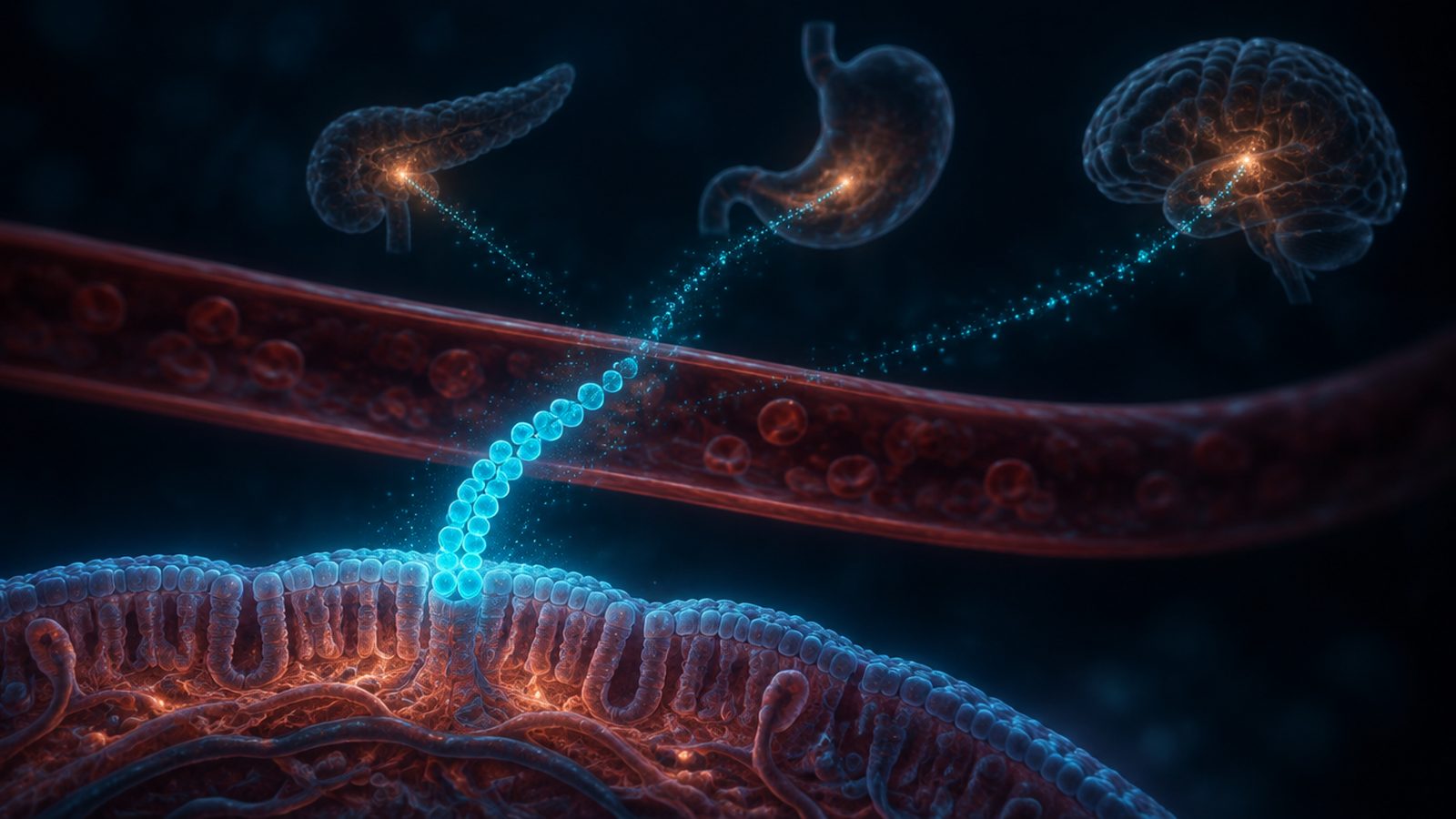
One lab-made peptide that fits the locks for three hormones at once: GIP, GLP-1 and glucagon. Meet the triple-key design and its striking trials.

Hormones are your body's messages. Each one fits its own spot on a cell, like one key for one lock.
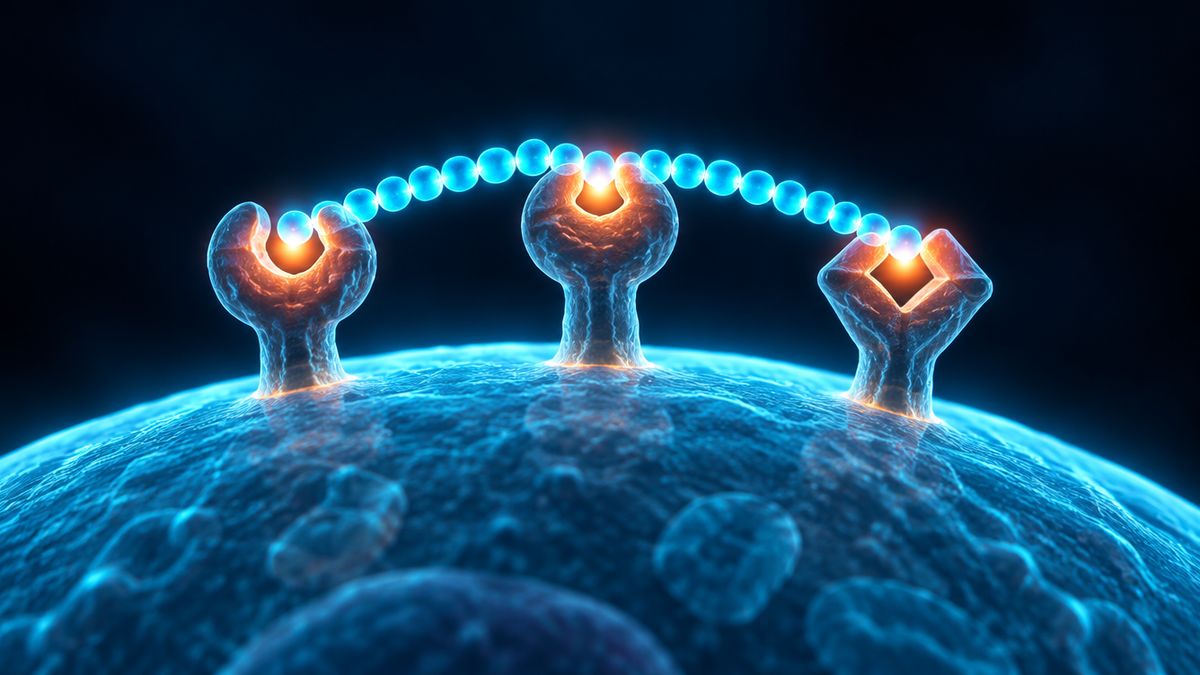
Retatrutide breaks that pattern in a brilliant way. It is a single peptide built to fit three locks at once. Can one key do the work of three? The answers so far have been striking.
What it is
A peptide is a short chain of amino acids. Think of amino acids as beads and a peptide as a short bead bracelet. New to this? Start with what a peptide is.
Retatrutide is a lab-made bead bracelet. In 2022, its maker, Eli Lilly, shared how it was built and first tested.
A hormone works by fitting a receptor on a cell. A receptor is a lock, and the hormone is the key.
Retatrutide fits three locks. Each one belongs to a different hormone: GIP, GLP-1 and glucagon.
What it does in the body
GIP and GLP-1 come from your gut. It sends them out after you eat.
Both help the pancreas release insulin. Insulin is the hormone that pulls sugar out of the blood. GLP-1 also helps turn down appetite. Learn more in our GLP-1 brief.
Glucagon is the surprise pick. It comes from the pancreas, and it works opposite to insulin. It pushes blood sugar up.
So why add it? Here is the clever part. Studies in animals show glucagon can also raise how much energy the body burns. It is like turning up the furnace in a house.

The GLP-1 part balances glucagon's push on blood sugar, because it helps lower blood sugar. One molecule, built-in teamwork.
What scientists have found
In cells: In lab tests on cells, retatrutide turned all three locks. It turned the glucagon and GLP-1 locks about equally. It turned the GIP lock more strongly.
In animals: In mice with obesity, retatrutide lowered body weight and blood sugar.
The three locks seemed to share the work beautifully. GIP and GLP-1 helped the mice eat less. Glucagon made them burn more energy. Together, they lost more weight.
In people: Then came the human trials. In 2023, a trial of 338 adults with obesity ran for 48 weeks. It was published in a top medical journal. In the highest-dose group, people lost 24% of their body weight on average.
The placebo group got a dummy look-alike. They lost about 2%.
That result set the stage for the big phase 3 trials, called TRIUMPH.

In September 2026, the first two full papers came out on the same day. Both were checked by outside experts first, a step called peer review.
The bigger trial had 2,339 adults with obesity but no diabetes. They took part for 80 weeks.
On the highest dose, average weight loss was 25%. On placebo, it was about 4%. People with knee arthritis had less knee pain. People with sleep apnea had fewer pauses in their breathing during sleep.
The other paper covered 1,152 adults with obesity and type 2 diabetes. Weight loss reached about 19% on the highest dose, versus 5% on placebo.
A third trial was in adults with severe obesity and heart or blood vessel disease. Those results so far come from the company, in a July 2026 press release, with the full paper still to come. It reported average weight loss of up to about 23%.
In these trials, the most common side effects were in the gut, like nausea and diarrhea.
Where it stands
Retatrutide is not FDA-approved yet. It is an investigational medicine, which means it is still being tested in studies.
Its maker says it plans to ask the FDA for approval in early 2027.
Up next is the full paper on the heart trial. Other trials are exploring heart and kidney health, fatty liver and back pain.
Scientists are also eager to learn what glucagon does in people over many years, and how the three locks team up in people. With so much underway, retatrutide is one to watch.
The bottom line
- Retatrutide is one clever lab-made peptide that fits three hormone locks: GIP, GLP-1 and glucagon.
- In mice, the glucagon part turned up the body's furnace, burning more energy on top of eating less.
- In large trials in adults with obesity, average weight loss on the highest dose reached about a quarter of body weight. It is not FDA-approved yet, and more trials are on the way.
FAQ
Questions people ask
- What is retatrutide?
- Retatrutide is a lab-made peptide cleverly built to fit three hormone locks: GIP, GLP-1 and glucagon. It is being tested in people with obesity and related health problems.
- Is retatrutide FDA approved?
- Not yet. As of October 2026, retatrutide is still being tested and is not FDA-approved. Its maker says it plans to ask for approval in early 2027.
- How is retatrutide different from GLP-1 medicines?
- GLP-1 medicines copy one hormone. Retatrutide fits the GLP-1 lock plus the GIP and glucagon locks, and in mice the glucagon part made the body burn more energy.
- How much weight did people lose on retatrutide in trials?
- In an 80-week trial of 2,339 adults with obesity, published in 2026, average weight loss was 25% on the highest dose, versus about 4% on placebo.
Sources7
- LY3437943, a novel triple glucagon, GIP, and GLP-1 receptor agonist for glycemic control and weight loss: From discovery to clinical proof of concept · Cell Metabolism, 2022 · DOI 10.1016/j.cmet.2022.07.013
- Incretin hormones: Their role in health and disease · Diabetes, Obesity and Metabolism, 2018 · DOI 10.1111/dom.13129
- Shared mechanistic pathways of glucagon signalling: Unlocking its potential for treating obesity, metabolic dysfunction-associated steatotic liver disease, and other cardio-kidney-metabolic conditions · Diabetes, Obesity and Metabolism, 2025 · DOI 10.1111/dom.70148
- Triple-Hormone-Receptor Agonist Retatrutide for Obesity - A Phase 2 Trial · New England Journal of Medicine, 2023 · DOI 10.1056/NEJMoa2301972
- Retatrutide, a Triple Hormone Receptor Agonist, for Treatment of Obesity (TRIUMPH-1) · New England Journal of Medicine (peer-reviewed, published online September 29, 2026), 2026 · DOI 10.1056/NEJMoa2604169
- Retatrutide in adults with obesity and type 2 diabetes (TRIUMPH-2): a double-blind, parallel-group, randomised, placebo-controlled, phase 3 trial · The Lancet (peer-reviewed, published online September 29, 2026), 2026 · DOI 10.1016/S0140-6736(26)01861-1
- Lilly's triple agonist, retatrutide, successful in two additional Phase 3 obesity trials, delivering significant improvements in weight and A1C · Eli Lilly and Company press release (PR Newswire), company announcement, not peer-reviewed, 2026
Education only. Not medical advice. The Cell Brief summarises published research for general education. It is not medical advice, and nothing here is a recommendation to use any compound.
One brief a week
One brief per compound. Unsubscribe anytime.